battery and holder for Citroën 2CValt
32 Articles


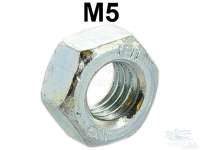
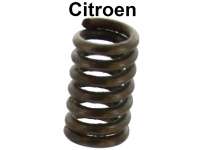
Battery holding hook, 215mm long. M5 thread. Suitable for Citroen DS, HY. 2CV etc. also suitable
for many Peugeot + Renault vehicles. Reproduction like original!
Battery mounting bracket from high-grade steel. Suitable for Citroen 2CV, Dyane. Made in Germany
Very sturdy construction!
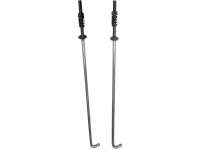
Battery box at the front wall, out of sheet metal. Suitable for Citroen 2CV. For battery: 12 V, 44
4 ampere. Length max.: 205mm. Wide one: 175mm. Height: 145mm.
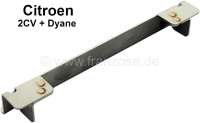

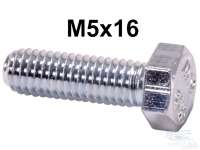
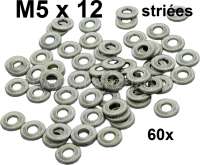
Battery box at the front wall, from high-grade steel. Suitable for Citroen 2CV. For battery: 12 V
V, 44 ampere. Length max.: 205mm. Wide one: 175mm. Height: 145mm. Made in Europe.
Battery charger - trickle charger for winter storage (OptiMate 1). Switchable between 6 volts and
12 volts. This small continuous charger is ideal for permanently connecting to a battery during the winter break. State-of-the-art technology protects against reverse polarity of the connections. It is suitable for normal lead batteries (those with acid). The maximum charging current is 0.6 amps. Please note: You cannot use this charger to quickly charge or reactivate empty batteries! It is therefore designed to keep the battery fresh and, if necessary, charge it very slowly. The scope of delivery also includes a charging cable that can be permanently connected to the battery. Simply route the plug connection to the outside and the charger can be connected without opening the bonnet.
Battery charger for 12 volts (OptiMate 6 Ampmatic). Charging capacity: 6 amps. The 'Swiss Army
knife' among battery chargers. You can connect all types of batteries (STD, AGM, EFB, GEL batteries). Almost all sizes can also be connected (3AH > 144Ah). This charger can even reactivate deeply discharged batteries (down to a discharge of 0.5 volts)! Its smart electronics make it possible. You can also test batteries. It has a safety circuit in case it is connected incorrectly. It controls the charging current according to the ambient temperature and has many other options. Whether it's a lawnmower, boat, car, motorhome, motorbike or tractor, this charger automatically adjusts to everything. And let's be honest, who knows what kind of battery is installed in modern vehicles these days? With this, it doesn't matter! Only modern electric vehicles cannot be charged with it! Of course, it can also be used as a normal battery maintenance charger. Our tip if you have several vehicles that are stored over the winter: get one of these chargers and equip the other vehicles with our maintenance chargers. The scope of delivery also includes a charging cable that can be permanently connected to the battery. Simply route the plug connection to the outside and the charger can be connected without opening the bonnet. Regular desulphation is important for a long service life of lead-acid batteries. And this is what these modern chargers can do.
Battery charger for 6 volts + 12 volts (OptiMate 5 6V/12V). Charging capacity: 3 amps at 12 volts
4 amps at 6 volts. This battery charger and trickle charger only charges lead-acid batteries (i.e. the batteries in classic cars). It can be used for both 6 volt and 12 volt batteries. This charger can also reactivate deeply discharged batteries (up to a discharge of 0.5 volts)! The clever electronics make it possible. You can also test batteries. It has a fuse circuit in case it is connected incorrectly. It controls the charging current according to the ambient temperature and has many other options. Regular desulphation is important for a long battery service life. And this is what these modern chargers can do.
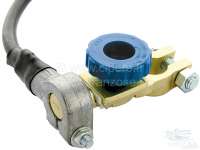
Battery pole switch bent (space-saving). Just release knurled head bolt to stop current circuit.It
can be very easily used when you do not use your car for long time(winter)! This switch replaces battery negative pole lead!

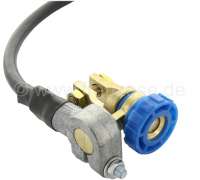
Battery pole switch. Just release knurled head bolt to stop current circuit.It can be very easily
used when you do not use your car for long time(winter)! This switch replaces battery negative pole lead!
Coloured battery terminals. Red for positive. Black for negative. Suitable for all types. The risk
of mixing up the terminals when connecting the battery is now minimised. These coloured battery terminal connectors are suitable for cables with a maximum diameter of 12 mm (cable cross-section up to 113 mm²). They fit terminal sizes of 16-19 mm. They are suitable for 6 V and 12 V batteries. And they look great too! Made in Germany. Designed for DIN A cone terminals with the following diameters: Positive terminal: 19.5 mm at the base of the cone, 17.5 mm at the top of the cone. Negative terminal: 17.9 mm at the base of the cone, 15.9 mm at the top of the cone. The positive terminal is therefore always larger than the negative terminal! The DIN A cone terminal is the standard connection used in Europe for lead-acid car batteries.
Battery pole negative - , Designed for DIN A cone terminals with the following diameters: Positive
terminal: 19.5 mm at the base of the cone, 17.5 mm at the top of the cone. Negative terminal: 17.9 mm at the base of the cone, 15.9 mm at the top of the cone. The positive terminal is therefore always larger than the negative terminal! The DIN A cone terminal is the standard connection used in Europe for lead-acid car batteries.
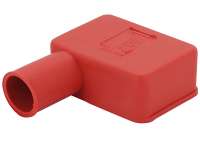
Battery pole positive +, Designed for DIN A cone terminals with the following diameters: Positive
terminal: 19.5 mm at the base of the cone, 17.5 mm at the top of the cone. Negative terminal: 17.9 mm at the base of the cone, 15.9 mm at the top of the cone. The positive terminal is therefore always larger than the negative terminal! The DIN A cone terminal is the standard connection used in Europe for lead-acid car batteries.
Battery pole plus + minus, with butterfly nut (colored in red + black). Universal suitable
Designed for DIN A cone terminals with the following diameters: Positive terminal: 19.5 mm at the base of the cone, 17.5 mm at the top of the cone. Negative terminal: 17.9 mm at the base of the cone, 15.9 mm at the top of the cone. The positive terminal is therefore always larger than the negative terminal! The DIN A cone terminal is the standard connection used in Europe for lead-acid car batteries.
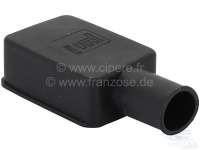
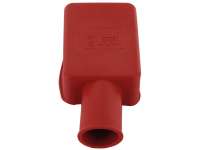
Battery pole protecting cap from rubber. Color: red. Length: 52mm. Width: 35mm. Long side on the
right - cable inlet down.
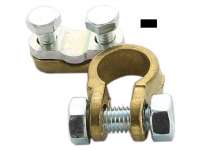
Battery terminals cleaning + milling cross. Indispensable for vintage cars! Trim once, and the
electrical contact is back in order.
Ground cable (battery ground strap), with battery pole clamp and ring tongue. Length: 250mm. Cable
diameter: 22mm ². Made in the European Union. Universal fitting.
Earth cable (battery ground strap), with battery pole clamp and eye ring. Length: 285mm. Made one
in the European Union. Universal fitting.
Ground cable (battery ground strap), with battery pole clamp and ring tongue. Length: 300mm. Cable
diameter: 22mm ². Made in the European Union. Universal fitting.
Ground cable (battery ground strap), with battery pole clamp ring tongue. Length: 350mm. Cable
diameter: 22mm ². Made in the European Union. Universal fitting.
Ground cable (battery ground strap), with battery pole clamp and ring tongue. Length: 400mm. Cable
diameter: 22mm ². Made in the European Union. Universal fitting.
Ground cable (battery ground strap), with battery pole clamp and ring tongue. Length: 500mm. Cable
diameter: 22mm ². Made in the European Union. Universal fitting.
Positive cable (battery to starter motor). Overall length: 500mm. Cable diameter: 16mm². Made in
the European Union. Universal fitting.
32 Articles
Why does a car battery discharge when the car isn't being driven?
We’d like to explain the physical process behind this.
Desulfation of Car Batteries
Desulfation is a process for regenerating lead-acid batteries—typically car batteries—whose capacity has been reduced by deposits of lead sulfate crystals.
Key facts at a glance
- Cause of sulfation: When a lead-acid battery is deeply discharged for an extended period or is rarely fully charged, hard sulfur deposits in the form of lead sulfate crystals form on the lead plates inside. These crystals insulate the plates, preventing the battery from accepting or releasing a charge.
- What does desulfation do? By using special chargers or battery pulsers, these hard crystals are broken down and returned to the electrolyte. This restores the active surface of the lead plates, and the battery’s capacity can be partially or fully recovered.
Methods for desulfation
- Battery chargers with a desulfation mode: These use special charging cycles, often with higher voltages or short pulses, to break up the crystals.
- Battery pulsers or Megapulse: These devices are connected to the battery permanently or temporarily and generate high-frequency current pulses that break down the deposits.
Important notes on battery regeneration
- Desulfation works best with mild to moderate sulfation.
- Desulfation can extend the life of an old battery, but it is no guarantee of repairing a completely defective battery.
- The process requires patience and can sometimes take several days.
- This method is only suitable for lead-acid batteries.
That is why it is important to distinguish between battery chargers: whether a battery is constantly charged and occasionally slightly discharged (which can already significantly extend its lifespan), or whether it is a charger with a desulfation function.
Battery chargers for classic cars and classic car batteries
We offer three different chargers for this purpose:
- A charger for 6-volt and 12-volt batteries that can only charge the battery. It does not have a desulfation function
- A charger for 6-volt and 12-volt batteries, but one that is only suitable for lead-acid batteries—that is, for the classic car battery that was predominantly used in the past. This charger has a desulfation function.
- A charger that supports only 12 volts. However, this charger is largely compatible with any battery connected to it. It can therefore also charge modern batteries, such as those used today in boats, RVs, lawn mowers, and cars. Of course, this charger can also charge and maintain the classic lead-acid battery in a classic car. This charger has a desulfation function.
However, you should always check whether a leakage current is flowing.
Leakage current in classic cars and dead batteries
Leakage current in classic cars is a common problem that often causes the battery to drain even after a short period of inactivity. While modern cars require a certain amount of standby current for control units, the cause in classic cars is usually due to aging or contamination.
Why classic cars often have leakage current
- Moisture and dirt: On the surfaces of insulators, such as the ignition coil or the battery, dust, grease, and moisture form a conductive coating through which current can flow unnoticed.
- Porous insulation: Old cable insulation cracks over time. Moisture penetrates and creates a conductive connection to the body, i.e., to ground.
- Corrosion: Exposed contacts, connectors, and ground points corrode over decades. Verdigris or rust increase resistance and can create leakage paths for the current.
- Stuck relays: Mechanical components such as old relays can get stuck in the on position, keeping a circuit permanently closed.
- Unfused loads: Often, the starter motor or alternator is connected directly to the battery. Defective diodes in the alternator can drain the battery overnight.
What you can do about it
- Clean the battery and terminals: Keep the battery surface dry and clean. Apply terminal grease to the connections to prevent corrosion and short circuits.
- Troubleshoot with a multimeter:
- Disconnect the negative terminal of the battery and connect a multimeter in series to measure current.
- Pull each fuse one by one. If the reading drops significantly when a specific fuse is pulled, you have found the faulty circuit.
- Install a battery disconnect switch: A so-called "bone" or "NATO bone" physically disconnects the battery from the vehicle's electrical system during extended periods of inactivity and reliably stops all current flow.
- Use a trickle charger: A smart charger compensates for small currents and keeps the battery in good condition while the vehicle is parked in the garage.
- Check cables and ground points: Clean corroded ground points on the body and replace brittle cables to prevent unwanted discharges.
If you cannot find the fault despite having blown fuses, the problem often lies with unsecured components such as the alternator or the starter motor. In most cases, the only solution is to disconnect these components specifically for testing.
 Select your Citroen


 Please select your Peugeot


 Please select your Citroen Renault