transmission for Renault AK-AZU
46 Articles


Drive shaft 2CV, oil seal on gearbox. Suitable for Citroen 2CV6 + 2CV4, Dayne, AK, Mehari, on which
the drive shaft flange is fixed with 6 bolts (i.e. all vehicles with disc brakes and the latest model years with drum brakes). Vehicles with 4 bolts need the oil seal 12294. Size: 31 x 42 x 8mm. Made in Germany.
Seal for drive shaft gearbox side with double universal joint. Suitable for Citroen 2CV4 + 2CV6
(starting from year of construction 1961 about 1973). The seal is of paper. Or. No. AM373-77. Inside diameter 82mm. Outside diameter 118mm.
Seal for drive shaft gearbox side with double universal joint. Suitable for Citroen 2CV4 + 2CV6
(starting from year of construction 1961 about 1973). The seal is of paper. Or. No. AM451-72A. Inside diameter 82,5mm.
Seal for drive shaft flange case at the gearbox. Suitable for Citroen 2CV4 + 2CV6 starting from
year of construction 1961). The seal is out of paper. Or. No. AT the 33186A
Spring suitable for the gear lever in the old gearbox, for Citroen 2CV from the fifties + sixties
es (gearbox shifter rod is rear at the gearbox). The spring is mounted under the gearbox cap. Or.Nr.A33497
Gearbox lid (cap) rear (with mounting for a reversing lamp switch). Suitable for Citroen 2CV6
Dyane. Or. No. 96995255

Gearbox cap seal for Citroen 2CV/AMI6, Dyane. Suitable for the old gearbox, Installed off about
year of construction 1963.
Gearbox locknut - M22x1.5 locking nut, behind the bearing of the 3rd shaft. Left-hand thread. Or
No. AZ332-4. Suitable for Citroen 2CV6, AK, Dyane, ACDY, Mehari, AMI
Gearbox Oil addetive, 20g. Suitable for 1 liter transmission oil. This additive has been specially
developed for manual and differential transmissions. The product significantly reduces wear and reduces temperature peaks which means quieter running, softer gear changes and better fuel-efficiency.
Bearing for drive shaft, in gearbox. Suitable for Citroen 2CV6. Dimension: 25 x 52 x 15mm. The
bearing is behind the oil seal. Original SKF. Our bearing has a groove for a circlip, but can also be mounted without.
Bearing gearbox - main shaft front, for 2CV. Original SKF. Measurement: 25x52x15mm, with groove for
retaining ring. Or.Nr.: ZC9620002U
Bearing primary shaft rear, reproduction. Suitable for Citroen 2CV6. Inside diameter: 20mm, outside
e diameter: 52mm, 57mm, overall height: 15mm, depth to stop in the case: 11,5mm. Or.Nr. ZC9620308
Bearing primary shaft, for Citroen 2CV6. Or. No.: 95572590. Reproduction. Dimension: 20x52x57x22mm
Depth gauge to bead seat wreath/ring: 19,00mm.
M9, stud bolt, for the mounting of the drive shaft at the gearbox. Suitable for Citroen 2CV +
Citroen DS. Measurement: M9x42mm.


Needle bearing suitable for the primary shaft, for Citroen 2CV, Inside diameter: 14,5mm, outside
e diameter: 20mm. Height of 26,5mm. Or.Nr. ZC9620373
Oil drain screw magnetically, suitable for Citroen 2CV, HY, DS, 11CV (with oil pan out of sheet
metal). Interior square. The suitable tool has our number 20221. Or. No. A1321M, thread M16x1,5x20

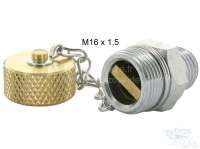
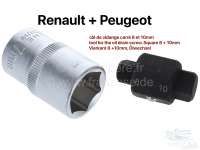
Gasket for oil drain plug for 2CV6, BX, XM, 204, 203, 304, 404, 504. inlet + exhaust screw
measure: 16,3x22x2mm. Version C, curved with a seal inside. (PTFE)
Gearbox shift sleeve (Selector wheel-disc) for the 2nd-3rd gear. Suitable for Citroen 2CV6, Dyan6
AK, ACDY, AMI, Mehari. Or. no. A335-96
Shifter rod bellows on the gearbox. Suitable for Citroen 2CV, early years of construction. Not
fitting for 2CV6! Or. No.: A33462
Fly wheel, shaft seal for the gearbox main shaft (primary shaft) in the fly wheel. Suitable for
Citroen for 2CV6. Size: 11,9x18x4mm. Or. No. 95495074. Made in Germany.
Fly wheel, shaft seal for the gearbox main shaft (primary shaft) in the fly wheel. Suitable for
Citroen for 2CV6. Size: 12x18x3mm. Or. No. 7903078053. Made in Germany.

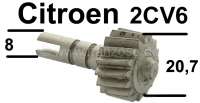
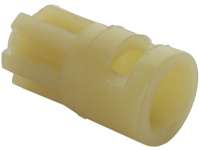
2CV6, speedometer pinion in gearbox. 16 theeth! The pinion has an outside diameter of 20,7mm, the
shank has a diameter of 8mm.
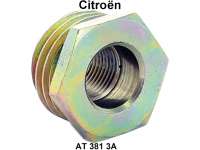
Identification plate green, for Citroen. 78x40mm. 2 bores. (Metal). The green identification plates
were often used for gearbox identification!
Guide sleeve in the gearbox, for the connection engine + gearboxes. For 2CV. Measurement
10x14x27,5mm. Very good after production from the European Union.
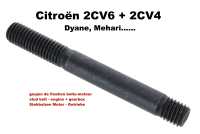
Motor-gearbox screw connection: Short stud bolts (these are the lower stud bolts) between the motor
and gearbox. Suitable for Citroën 2CV6 + 2CV4, Dyanne AMI8, Mehari
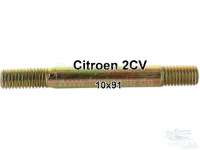

Motor-gearbox screw connection: long stud bolts (these are the upper stud bolts, as they also hold
the air filter holder) between the motor and gearbox. Suitable for Citroën 2CV6 + 2CV4, Dyane, AK, Ami8
46 Articles
The Citroën 2CV Fourgonnette is the commercial vehicle variant of the classic 2CV series. This family includes the AZU, AK, AKS, AK 350, AK 400, and other 2CV-based panel van models. Although these vehicles are technically closely related to the 2CV, Dyane, Ami, Méhari, and Acadiane, there are significant differences in their transmissions.
The transmission is particularly important in the Fourgonnette models because these vehicles were frequently used as transporters. Load capacity, longer gear ratios, more powerful or less powerful engines, different braking systems, and varying model years all play a major role. A transmission should therefore never be judged solely on whether it fits mechanically.
Citroën 2CV Fourgonnette Transmissions: AZU, AK, AKS, and AK 400
The following factors are always decisive:
- Vehicle type
- Engine type
- Year of manufacture
- Brake system
- Brake fluid
- Gear ratio
- Clutch type
- Drive shafts
- Speedometer cable drive
- Intended use of the vehicle
2CV Fourgonnette: What belongs to this vehicle family?
The term “Fourgonnette” refers to the panel van and delivery van variants based on the 2CV. Over the course of production, there were various models with different engines and technical specifications.
Typical models include:
| Model | Classification |
|---|---|
| 2CV AU / early Fourgonnette | Early commercial vehicle version based on the 2CV |
| AZU | Classic small 2CV Fourgonnette |
| AK | larger and more powerful commercial vehicle variant |
| AKS / AKS 400 | advanced panel van version |
| AK 350 / AK 400 | Commercial vehicle with larger cargo capacity |
| Acadiane | Later panel van variant related to the Dyane |
Important: Although the Acadiane technically belongs to the same A-model family, it is not simply a Dyane or an AK 400. Here, too, the transmission, brake system, and add-on parts must be thoroughly inspected.
Basic design of the Fourgonnette transmission
The transmission of the 2CV Fourgonnette is based on typical A-model technology. It is a 4-speed transmission with reverse gear. The 2nd, 3rd, and 4th gears are synchronized. The 1st gear is not synchronized.
In practice, this means: First gear should only be engaged when the vehicle is stationary. If it is engaged while the vehicle is rolling or still in motion, significant shifting noises may occur. This is not necessarily a defect, but rather a design feature.
If 1st gear is difficult to engage while the vehicle is stationary, the following procedure often helps: briefly shift into 2nd gear and then shift into 1st gear. This allows the gears to align better.
Why Fourgonnette transmissions must be evaluated differently
In a sedan, driving comfort is often the priority. In a Fourgonnette, however, its utility vehicle function is decisive. The vehicle was built for transport, loading, trades, agriculture, delivery services, and daily work.
Therefore, a Fourgonnette transmission must be evaluated differently than a transmission from a 2CV6, a Dyane, or an Ami.
Important differences arise from:
| Area | Significance for the Fourgonnette |
|---|---|
| Loading | Higher weight puts strain on the clutch, transmission, and drivetrain |
| Gear ratio | Must be matched to engine power and payload |
| Engine | Smaller engines tend to require a shorter gear ratio |
| Brake system | must be compatible with the transmission and fluid system |
| Application | City traffic, country roads, inclines, or transport |
| Modifications | Many vehicles have undergone technical modifications over the years |
A longer gear ratio can be comfortable on flat terrain. However, when loaded or on inclines, it can result in the engine lacking power and requiring more frequent downshifting.
AZU, AK, and AKS: Differences in Engine and Transmission
The Fourgonnette models were built over many years and underwent several technical modifications. Earlier AZU models had smaller engines and were therefore gear-ratioed differently than later AK or AKS models.
| Model | Typical technical classification | Note on the transmission |
|---|---|---|
| AZU | Smaller, classic Fourgonnette | Transmission must be compatible with the smaller engine |
| AK | More powerful commercial vehicle variant | Check for different gear ratios and load capacity |
| AKS | Upgraded version | Note technical changes depending on the year of manufacture |
| AK 400 | Larger panel van variant | Take into account the load and longer body |
| Acadiane | Later A-model fourgonnette | often equipped with 602-cc technology, but check independently |
Caution is advised, especially with older vehicles: Over the decades, engines and transmissions have frequently been replaced. A built-in transmission may therefore not correspond to the original factory specifications.
Gear ratios for AZU, AK, and other van models
The gear ratio is one of the most important factors when selecting a transmission. It determines how well the vehicle accelerates, how powerful it is on hills, and what the engine RPM is at cruising speed.
For commercial vehicles, a suitable gear ratio is particularly important. A transmission with too long a gear ratio can be uncomfortable when loaded because the engine struggles to reach the desired RPM. A transmission with too short a gear ratio improves acceleration but increases RPM at higher speeds.
| Transmission Type / Model | Character | Effect in practice |
|---|---|---|
| Early AZU transmissions | Designed primarily for smaller engines | Suitable for low power and utility operation |
| AK / AKS transmissions | Designed for commercial vehicles | Designed for heavy loads and everyday use |
| AK 400 / Acadiane | Depending on the model, longer-lasting or usage-oriented | Depending on engine, year of manufacture, and application |
| 2CV6 transmission | often rather short | good low-end torque, higher RPM |
| Dyane / Ami transmission | often longer | smoother at speed, less power on hills |
For a Fourgonnette, the longest gear ratio isn’t automatically the best choice. Especially when the vehicle is loaded, on hilly terrain, or during frequent starts, a shorter or appropriately matched commercial vehicle gear ratio often makes more sense.
Can a 2CV6, Dyane, or Ami transmission be installed in a Fourgonnette?
Many A-model transmissions appear similar at first glance. In some cases, they can also be mechanically installed. Nevertheless, such a swap is not automatically advisable.
Before installing a different transmission, the following points must be checked:
| Checkpoint | Why is this important? |
|---|---|
| Gear ratio | affects acceleration, torque, and RPM |
| Brake system | Drum or disc brakes must be compatible |
| Brake fluid | Do not mix DOT/Lockheed or LHM |
| Clutch | Note the model and year of manufacture |
| Drive shafts | Check flanges and lengths |
| Speed sensor cable drive | May vary depending on the transmission |
| Handbrake | Drum and disc brakes differ |
| Engine power | Smaller engines handle long gear ratios less well |
| Payload | A loaded Fourgonnette requires adequate power delivery |
A 2CV6 transmission can provide good low-end torque, but it isn’t automatically suitable for every Fourgonnette. A Dyane or Ami transmission may have longer gear ratios and feel smoother on country roads, but it can be too sluggish when loaded or on inclines.
For a Fourgonnette, everyday practicality under load should be prioritized over achieving the lowest possible RPM at top speed.
Drum Brake System on the 2CV Fourgonnette
Many early Fourgonnette models have internal front drum brakes mounted on the transmission. These vehicles use classic DOT- or Lockheed-based brake fluid.
Typical features:
| Feature | Drum brake transmission |
|---|---|
| Front wheel brake | Internal drums on the transmission |
| Brake fluid | DOT / Lockheed |
| Hand brake | acts on the front drums |
| Transmission housing | without mounting for disc brake calipers |
| Used | typical for older A-model versions |
On a Fourgonnette with a drum brake system, a disc brake kit should not be installed without adapting the entire brake system accordingly. This includes the master cylinder, lines, seals, parking brake, and other components.
Disc brake gearboxes in later A-model Fourgonnette models
Later vehicles from the A-Model family may be equipped with internal disc brakes. These use LHM, i.e., green mineral hydraulic fluid.
Typical features:
| Feature | Disc brake system |
|---|---|
| Front wheel brake | Internal brake discs on the transmission |
| Brake fluid | LHM, green, mineral |
| Hand brake | Separate handbrake pads on the disc brake |
| Transmission housing | with mounting for brake calipers |
| Seals and lines | must be compatible with LHM |
Important: Hydraulic brake fluid (LHM) and DOT/Lockheed brake fluid must never be mixed. The components and seals are designed for different fluids. Mixing them can cause serious damage to the brake system.
Conversion from drum brakes to disc brakes on Fourgonnette models
Converting from drum brakes to disc brakes is not a simple gear change. It affects the entire braking system.
The following, among other things, must be checked or adjusted:
| Area | Checkpoint |
|---|---|
| Transmission housing | Is there a mounting for a disc brake system? |
| Brake calipers | compatible with the system? |
| Handbrake mechanism | Different design for disc brakes |
| Master cylinder | Compatible with LHM or DOT? |
| Brake lines | Compatible materials? |
| Rear wheel brake cylinders | Compatible with the fluid system? |
| Brake fluid reservoir | Clearly labeled? |
| Seals | Suitable for the fluid used? |
A mixed system consisting of DOT/Lockheed components and LHM components should be avoided at all costs.
Reverse gear on AZU, AK, and Fourgonnette: Use only briefly and slowly
The reverse gear on the 2CV Fourgonnette is intended for maneuvering. This is especially true for commercial vehicles, as higher loads can often occur when reversing, for example when loading, on inclines, in driveways, or on unpaved surfaces.
Prolonged reverse driving, high RPMs, or heavy acceleration in reverse should be avoided.
It is known that in A-model transmissions, prolonged or forceful reverse driving can lead to a jam. The cause is usually not directly related to reverse gear itself, but rather to a component in the area of the sliding sleeve for 2nd and 3rd gears.
There is a locking or threaded bushing located there. If this bushing loosens, the sliding body can shift too far. This can cause shifting components in the transmission to jam. The transmission then behaves as if two gears were engaged simultaneously.
Why is reverse gear particularly critical in a Fourgonnette?
In a small van, the load places more weight on the drivetrain. Driving uphill in reverse, maneuvering on grass, or backing up with heavy acceleration places high stresses on the transmission.
This can be particularly problematic if the transmission is already worn or if a safety mechanism inside is no longer functioning reliably.
Therefore:
Only drive in reverse slowly, for short distances, and without high loads.
You should especially avoid:
- longer reverse trips over driveway entrances
- Reversing at high RPM
- Heavy acceleration in reverse
- Reversing with a heavy load on inclines
- Forcing the vehicle to move when it is stuck
- Shifting back and forth between forward and reverse gears
Typical signs of a seized Fourgonnette transmission
The following symptoms may indicate a blockage in the transmission:
| Symptom | Possible meaning |
|---|---|
| A metallic noise occurs after driving in reverse | A safety device or shift component may have come loose |
| The vehicle will not move | The transmission may be internally locked |
| The clutch engages, but the drive remains locked | Probable transmission malfunction |
| The shift lever feels unusual | Shift forks or shift sleeves may be misaligned |
| The transmission feels as if two gears are engaged | Shift components may be jammed |
| The wheels lock up when starting | Possible internal transmission lockup |
In this situation, do not force the gearshift, attempt to drive off, or use the starter motor. Doing so may cause further damage to the gears, shift sleeves, or shift forks.
What to do if the transmission locks up?
If the transmission locks up after driving in reverse, the vehicle should be secured immediately and not moved any further.
Recommended procedure:
- Secure the vehicle to prevent it from rolling away.
- Do not shift gears or drive off.
- Do not force the shift lever.
- Do not use the engine to release the lockup.
- Check the upper transmission cover.
- Check the position of the shift sleeves and shift forks.
- Position the loose retaining bushing correctly and secure it.
- Check the transmission oil for metal particles.
- Carefully check all gears before a test drive.
With a bit of luck, the cause can be identified and resolved by inspecting the upper transmission cover. Whether this is sufficient depends on whether secondary damage has already occurred.
When does a Fourgonnette transmission need to be removed?
Removal and complete disassembly are recommended if significant damage is visible or if the transmission continues to exhibit issues after the initial inspection.
| Findings | Recommendation |
|---|---|
| Retaining bushing severely damaged or loose | Disassemble and inspect the transmission |
| Teeth damaged or broken | Complete technical inspection required |
| Sliding sleeve damaged | Replace component |
| Shift fork bent | Inspect or replace shift fork |
| Metal particles in the oil | Clean and inspect the transmission |
| Squealing noises after repair | Check bearings, bevel gear, and ring gear |
| Gear pops out | Check the shift sleeve, detent, and bearings |
A loose bushing should not simply be screwed back in. It must be permanently secured. Depending on its condition, options include clean caulking, suitable threadlocker, or a professional mechanical lock.
Typical weak points in AZU, AK, and Fourgonnette transmissions
In addition to the reverse gear problem, there are other typical wear points.
Shifting problems and synchronizer rings
Cracking or sticking when shifting, especially between 2nd and 3rd gear or when downshifting from 3rd to 2nd gear, often indicates worn synchronizer rings.
Possible causes:
| Cause | Description |
|---|---|
| Worn synchronizer rings | Common cause of shifting noises |
| Worn shift sleeve | Gear does not engage properly |
| Worn guides | Imprecise shifting feel |
| Incorrect or old transmission fluid | Poor shifting performance |
| High load over a long period | Additional strain on the transmission |
Bearing noises
Howling, humming, or grinding noises should be taken seriously.
| Noise | Possible cause |
|---|---|
| Howling under load | Bevel gear, ring gear, or bearing |
| Rattling at idle | Input bearing, primary shaft, or clutch area |
| Roaring in all gears | Main bearing or differential bearing |
| Noise only in one gear | Gear pair or gear bearing |
| Loud whining under load | Wear or incorrect adjustment under load |
Leaks
Leaks are common in older commercial vehicle transmissions. Due to higher mileage and heavy-duty use, van transmissions are often subjected to greater stress than those in passenger cars.
| Location | Possible cause |
|---|---|
| Output flanges | Hardened oil seals or worn-in contact surfaces |
| Shift cover | Old gasket |
| Speedometer cable drive | Defective sealing ring |
| Drain and fill plug | Old sealing rings |
| Case seam | Inadequate sealing following a previous repair |
| Collar area | Age-related cracks or leaks |
Transmission oil for 2CV Fourgonnette, AZU, AK, and AKS
Most transmissions in the 2CV Fourgonnette family typically require about 0.9 liters of transmission fluid. The correct fill level is reached when oil leaks out of the side check port.
Recommendation for normal road use:
| Point | Recommendation |
|---|---|
| Quantity | approx. 0.9 liters |
| Viscosity | SAE 75W80 |
| Specification | Preferably mineral GL-4 gear oil |
| Filler level | until oil leaks from the inspection port |
| Inspection | Check regularly on commercial vehicles |
| Not recommended | Engine oil, ATF, or very thin low-viscosity oils |
In a commercial vehicle, the oil level should be checked with particular care. Loading, city traffic, stop-and-go driving, and frequent maneuvering place a greater strain on the transmission than steady driving in a light passenger car.
If the vehicle’s history is unknown, the transmission fluid should be changed and checked for metal particles, water, or a burnt smell.
Inspect van transmissions before installation or repair
Before installation, purchase, or repair, a transmission for AZU, AK, AKS, or AK 400 should be thoroughly inspected. Many vehicles have been modified, repaired, or equipped with parts from other A-series models over the years.
Important checkpoints:
- Which vehicle type did the transmission originally belong to?
- Is the transmission compatible with AZU, AK, AKS, or AK 400?
- What engine is installed in the vehicle?
- What is the gear ratio of the transmission?
- Is it a drum brake or disc brake transmission?
- Is DOT/Lockheed or LHM used?
- Are the clutch, drive shafts, and speedometer cable drive compatible?
- Does the parking brake mechanism work properly?
- Are there any shifting problems or noises?
- Are there any visible leaks?
- Is the correct transmission fluid used?
- Has the vehicle already undergone any technical modifications?
FAQs on 2CV Fourgonnette, AZU, AK, and AK 400 transmissions
Which transmission fits in a 2CV Fourgonnette?
That depends on the model, year of manufacture, engine type, and brake system. An early AZU requires a different configuration than a later AK or AK 400. The key factors are gear ratio, brake system, clutch, drive shafts, and speedometer cable drive.
Is a 2CV6 transmission suitable for a Fourgonnette?
A 2CV6 transmission may fit mechanically, but it is not necessarily the best choice. It can provide good low-end torque, but it must be compatible with the braking system, clutch, and intended use.
Is a Dyane or Ami transmission suitable for an AK or AZU?
A Dyane or Ami transmission may have a longer gear ratio. This can be pleasant when the vehicle is empty, but can lead to sluggish handling when loaded or on inclines.
Why is the gear ratio so important for a Fourgonnette?
A Fourgonnette is often driven with a load. A transmission with too long a gear ratio can overwork the engine. A suitable commercial vehicle gear ratio improves acceleration, torque, and everyday usability.
Can LHM be mixed with DOT/Lockheed brake fluid?
No. LHM and DOT/Lockheed brake fluid must never be mixed. The seals and components are designed differently and can be damaged.
Why does 1st gear make a clunking noise when engaged?
First gear is not synchronized. It should only be engaged when the vehicle is stationary. Shifting noises when engaging while rolling are possible due to the design.
Why might the transmission lock up after driving in reverse?
During prolonged or heavy-load reverse driving, a retaining bushing in the area of the sliding sleeve may come loose. This can cause shifting components to jam and the transmission to lock up.
How should reverse gear be used in a van?
Reverse gear should only be used slowly, briefly, and without heavy loads. This applies especially when carrying a load, on inclines, or on unpaved surfaces.
What should you do if the transmission locks up?
The vehicle should not be moved any further. Do not force the gearshift or attempt to drive off. Checking the upper transmission cover is the first sensible step.
Why are Fourgonnette transmissions often more worn out?
Many vans were used as work vehicles. Loading, frequent maneuvering, city traffic, and high mileage can put more strain on the transmission, clutch, and drivetrain than in a sedan.
Summary
The transmission for a Citroën 2CV Fourgonnette must always be selected to match the vehicle type, engine, braking system, and intended use. While the AZU, AK, AKS, AK 400, and Acadiane belong to the same A-model family, they differ in important technical details.
For commercial vehicles, the gear ratio is particularly important. A transmission with too long a gear ratio may be unsuitable when loaded or on inclines. A transmission with too short a gear ratio offers good low-end torque but increases engine speed at cruising speeds.
DOT/Lockheed brake fluid is used in transmissions with drum brakes. LHM is used in transmissions with disc brakes. The two systems must not be mixed.
The reverse gear on all Fourgonnette models should only be used for slow maneuvering. Prolonged driving in reverse or heavy loads can cause components in the shift mechanism to loosen and the transmission to seize.
Every Fourgonnette transmission should be carefully inspected before installation, conversion, or repair. This helps prevent mispurchases, consequential damage, and issues with the gear ratio, braking system, or shift mechanism.
 Select your Citroen


 Please select your Peugeot


 Please select your Citroen Renault