Why does a car battery discharge when the car is not in use?
If a car isn’t driven for an extended period, the car battery can discharge. There are physical and technical reasons for this. Sulfation, incomplete charging, and leakage current play a particularly important role in classic cars.
Desulfation of Car Batteries
Desulfation is a process for regenerating lead-acid batteries, typically classic car batteries. The goal is to restore the capacity of a battery that has been reduced by deposits of lead sulfate crystals.
Key facts about sulfation
- Cause of sulfation: When a lead-acid battery is deeply discharged for an extended period or is rarely fully charged, hard deposits of lead sulfate crystals form on the lead plates. These deposits insulate the plates, preventing the battery from absorbing or releasing charge.
- Effect of desulfation: Using special battery chargers or battery pulsers, these crystals can be partially broken down and returned to the electrolyte. This improves the active surface area of the lead plates, allowing the capacity to recover partially or even largely.
Methods for desulfating lead-acid batteries
- Battery chargers with a desulfation mode: These devices use special charging cycles, often with higher voltages or short pulses, to dissolve sulfate crystals.
- Battery pulsers or Megapulse: These devices are connected to the battery continuously or intermittently and generate high-frequency current pulses designed to break down deposits.
Important notes on battery regeneration
- Desulfation works best for mild to moderate sulfation.
- It can extend the life of an old battery, but is no guarantee of repairing a completely defective battery.
- The regeneration process requires patience and can take several days.
- This method is only suitable for lead-acid batteries.
That is why it is important to distinguish carefully when selecting a battery charger: does the device merely charge and maintain the battery, or does it also feature a desulfation function? Even regular trickle charging can significantly extend the service life of a classic car battery.
Battery chargers for classic cars and classic car batteries
We offer three different chargers for classic cars and vintage vehicles:
- A charger for 6-volt and 12-volt batteries that is used exclusively for charging. It does not have a desulfation function.
- A charger for 6-volt and 12-volt batteries that is suitable only for lead-acid batteries—that is, for the classic car battery that was predominantly used in the past. This charger features a desulfation function.
- A 12-volt charger that can be used with many different battery types. It is therefore also suitable for modern batteries in boats, RVs, lawn mowers, and cars. Of course, this charger can also charge and maintain the classic lead-acid battery in a classic car. This charger also features a desulfation function.
As a general rule, whenever a battery is discharging, you should always check for leakage current.
Leakage Current in Classic Cars and Dead Batteries
Leakage current is a common problem in classic cars and is often the reason why the battery is already dead after just a short period of inactivity. While modern vehicles require a certain amount of standby current for control units, unwanted current losses in classic vehicles are usually caused by aging, moisture, or dirty electrical connections.
Why classic cars often have leakage current
- Moisture and dirt: Dust, grease, and moisture can form a conductive coating on insulators, such as those on the ignition coil or the battery. Current flows through this coating unnoticed.
- Porous insulation: Old cable insulation becomes brittle and cracked over time. Moisture that penetrates can then create a conductive connection to the body and thus to ground.
- Corrosion: Contacts, connectors, and ground points corrode over decades. Verdigris or rust not only increase resistance but can also create unwanted leakage paths.
- Stuck relays: Mechanical relays can get stuck in the on position, keeping a circuit permanently closed.
- Unprotected loads: The starter motor or alternator is often connected directly to the battery. Defective diodes in the alternator can even drain the battery overnight.
What you can do to prevent leakage current
- Clean the battery and terminals: Keep the battery surface clean and dry. Apply terminal grease to the connections to reduce corrosion and leakage paths.
- Troubleshooting with a multimeter:
- Disconnect the negative terminal of the battery and connect a multimeter set to amperage measurement in series between the terminals.
- Then pull each fuse one by one. If the reading drops significantly when a specific fuse is pulled, the affected circuit has been found.
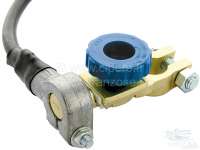
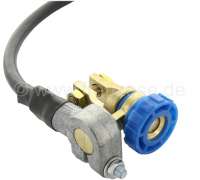
- Install a battery disconnect switch: A so-called "bone" or "NATO bone" completely disconnects the battery from the vehicle electrical system during extended periods of inactivity and reliably prevents any current flow.
- Use a trickle charger: A smart charger compensates for minor current losses and keeps the battery in good condition during periods of inactivity.
- Check cables and ground points: Clean corroded ground points on the body and replace brittle cables to prevent unwanted discharges.
If the fault cannot be found despite blown fuses, the cause often lies in unprotected components such as the alternator or starter motor. In this case, the only effective solution is usually to disconnect these components specifically for testing.



 Select your Citroen


 Please select your Peugeot


 Please select your Citroen Renault