2CV, bracket (welded) for the gear lever. Suitable for Citroën 2CV, AK, AZU. This bracket is
welded from above the storage compartment (dashboard).


welded from above the storage compartment (dashboard).
heads) + gearshift diagram! Colour black. Suitable for Citroen 2CV, Dyane, Mehari
Citroen 2CV, Dyane, Mehari
lever interior onto the gear lever to the gearbox.
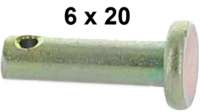
2CV. Measurement: 6x20mm. Or.Nr.: A334-57
lever on the gearbox. (without rubbers). Suitable for Citroen 2CV.
for Citroen 2CV. This connector is mounted between the gearstick lever from the passenger compartment and the gearstick lever on the gearbox.
lever from the vehicle interior and the gear lever on the gearbox.
fitting for 2CV6! Or. No.: A33462
In early Citroën 2CV models with 375 cm³ and 425 cm³ engines, the shift rod should not be equated with the later shift mechanism found in the 2CV4 or 2CV6. However, the basic principle of the typical 2CV gearshift remains the same: the gearshift lever is pulled, pushed, and turned. The design of the shift rod, the routing through the bulkhead, and in some cases the gearshift mechanism itself differ significantly, however.
Especially with early 2CV A, 2CV AU, 2CV AZ, AZL, AZU, and AZAM models, it is important to carefully check the existing shift rod design. An incorrect shift rod can result in gears being difficult to engage, the shift rod sitting crookedly in the dashboard, or the shift linkage being under tension.
Although the early Citroën 2CV models also feature the familiar horizontal dashboard gearshift, the technical design has changed over the years. In particular, vehicles with 375 cm³ engines and early 425 cm³ models up to around July 1966 differ from later 2CV4 and 2CV6 versions.
Broadly speaking, three groups can be distinguished:
| Period / Type | Engine | Gearshift |
|---|---|---|
| Early 2CV A and 2CV AU | 375 cm³ | Very early version with separate shift rod and feed-through |
| 2CV AZ, AZL, AZU, AZAM up to approx. 07/1966 | 425 cc | Old shift rod version with its own bulkhead grommet |
| from approx. 07/1966 and later 2CV4 and 2CV6 | 425, 435, and 602 cm³ | Later shift rod with modified length, guide, and passage |
The key point: Even among early 2CVs, there are different versions. Therefore, when restoring, repairing, or replacing parts, one should not simply search for “2CV shift rod.” The model, year of manufacture, engine type, transmission version, and the actual shift rod installed are all important.
The early 2CVs with 375 cm³ engines, particularly the 2CV A and 2CV AU Fourgonnette, feature the typical 2CV gearshift with a horizontal gear lever in the dashboard. However, this is a very early technical design.
Typical features of 375-cc models:
Therefore, a later shift rod for the 2CV4 or 2CV6 should not be used indiscriminately on a 375cc 2CV. Even shift rods for older 425cc models may differ on very early vehicles.
The 425-cc models, such as the 2CV AZ, AZL, AZU, and AZAM, feature an older shift rod design that is generally relevant up to around July 1966. Although these vehicles already feature the familiar 2CV shifting mechanism, they differ from later models in important details.
Typical differences include:
In practical terms, this means: An early 425 2CV cannot automatically be considered equivalent to parts from a later 2CV4 or 2CV6. If the parts do not fit properly, the shift mechanism may appear installable but often does not function smoothly.
Starting around July 1966, a later shift rod design was used in many 2CV models. This design is more closely related to the later 2CV4 and 2CV6 shift rods.
Nevertheless, even with later vehicles, a thorough check is necessary. For example, different lengths are known for the 2CV4 and 2CV6, such as 630 mm and 660 mm. Therefore, it is advisable to measure the existing shift rod before replacement and compare it with the vehicle model.
Important: The model alone does not determine the correct shift rod. The year of manufacture, transmission, body style, and existing installation situation are also decisive factors.
The early shift rod is not simply an older version of the later 2CV6 shift rod. It can differ in length, angle, connection, and geometry. Especially in restored vehicles, it is often no longer certain whether the original version is still installed.
Possible differences:
Even small deviations can prevent the gears from being engaged properly.
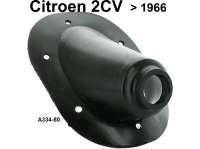
The gearshift rod feed-through at the bulkhead is particularly important in early 2CVs. The rubber boot must fit the gearshift rod design and the body.
If the wrong boot or the wrong routing is used, the shift rod may:
An ill-fitting splash guard seal is therefore not just a cosmetic issue, but can directly affect the function of the transmission.
The basic principle remains the same: the shift rod moves the lever on the transmission via a linkage. However, early transmissions may have different protective and boot components installed. The operation of the transmission may also differ in detail from later versions.
Therefore, on early 375-cc and 425-cc models, not only the shift rod but also connecting parts, bushings, boots, and lever position should be checked.
The shift pattern generally corresponds to the typical 2CV four-speed transmission with reverse. It is operated via the horizontal shift lever in the dashboard by pulling, pushing, and turning.
However, it is important to note: Early 2CV transmissions drive differently than later 2CV6 transmissions. Even though the shifting logic is similar, older transmissions are often more sensitive to play, wear, clutch adjustment, and sloppy shifting movements.
It is therefore recommended that you:
An incorrect shift rod is one of the most common causes of shifting problems in early 2CVs. A later-model rod may be installed under certain circumstances, but the shift geometry will not fit correctly.
Typical symptoms:
On early 2CVs, the boot on the dashboard is a key component of the shift linkage. If it is incorrect, damaged, or missing entirely, the shift rod cannot function properly.
Possible consequences:
As with later 2CV models, the bushings on the connector between the shift rod and the gearshift lever can wear out in early models as well. This creates play, which is clearly noticeable on the long gearshift lever.
Typical symptoms:
In older vehicles, improvisations were often made over the decades. A slightly bent shift rod may appear unremarkable from the outside, but it alters the entire shifting geometry.
Typical signs:
In restored early 2CVs, the fender, battery box, dashboard area, or transmission housing were often repaired. If the routing or mounting was altered by even a few millimeters during this process, the shift geometry may no longer be correct.
Possible symptoms:
For early 2CVs, the specific model should be identified before making any adjustments. Simply readjusting the system is of little use if the wrong shift rod, an ill-fitting boot, or a tight connection is installed.
Important checkpoints:
Especially with early vehicles, the term “old 2CV” is too vague. The exact model must be checked on the vehicle.
The shift linkage should only be adjusted once the correct shift rod is installed and all bushings, boots, and connecting parts are in good condition.
First, determine which shift rod model the vehicle requires. This is particularly crucial for 375-cc and 425-cc models up to approximately July 1966.
The shift lever must not rub against either the mudguard or the boot. In the neutral position, the shift rod should sit freely and as centered as possible.
The following should be checked:
The connection to the gearshift lever must be free of play but still movable. Bushings, bolts, washers, and locks must be properly seated. The connection must not be installed under tension.
The transmission should be in neutral. The shift lever in the passenger compartment should also be in the neutral center position. Only then should the connection be installed so that it fits without tension or torsional stress.
With the engine off and the clutch depressed, all gears should be checked:
If the gears can only be engaged by pressing the lever hard against the dashboard or by twisting it unusually, the geometry of the shift linkage is incorrect.
In the later 2CV6, shifting problems are often due to bushings, play, or incorrect adjustment. In early 2CVs with 375 cm³ or 425 cm³ engines, there is an additional important point: You must first check whether the correct shift rod configuration is installed at all.
For early 2CVs, there are at least these relevant variants:
For a proper repair or restoration, the existing shift rod should therefore always be measured, photographed, and cross-referenced with the model, year of manufacture, body type, and transmission version.
If the shifting in an early Citroën 2CV feels imprecise, stiff, or binds, do not immediately attempt to adjust it. First, the installed shift rod should be inspected. Especially in 375-cc and early 425-cc models, an incorrect shift rod can be the cause of many problems.
Precise shifting is only achieved when the shift rod, bulkhead bushing, sleeves, bushings, and gearshift lever are properly matched. If incorrect parts are installed or existing parts are installed with misalignment, the shift linkage cannot be permanently adjusted correctly.
Not necessarily. Early 2CVs with 375 cm³ or 425 cm³ engines may have different shift rods, different bulkhead bushings, and different boots. The existing configuration should be carefully checked before replacement.
Typical signs include a misaligned shift rod, crushed boots, gears that are hard to engage, a reverse gear that’s hard to find, or a transmission that doesn’t shift smoothly despite having bushings with no play.
Particularly relevant are the 2CV A and 2CV AU with 375 cm³ engines, as well as the 2CV AZ, AZL, AZU, and AZAM with 425 cm³ engines, up to approximately July 1966.
The bulkhead boot guides and seals the shift rod in the area of the body pass-through. If it is incorrect or damaged, the shift rod can rub, jam, or be under tension. In addition, water, drafts, and odors can enter the interior.
Possible causes include an incorrect shift rod, worn-out bushings, a bent rod, a tight fit, an incorrect bulkhead passage, or a clutch that isn’t disengaging properly.
Before adjustment, the shift rod design, length, shape, bulkhead boot, transmission boot, bushings, connecting parts, clutch, and neutral position should be checked.
The shift rod design was modified over the course of production. The cutoff point around July 1966 is particularly important, as the design, routing, and subsequent parts assignment may differ.








 Select your Citroen


 Please select your Peugeot


 Please select your Citroen Renault