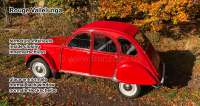
2CV 6 NJHC decoration set (2CV NJHC ovvero Nederlandse Jeugdherberg Centrale), completely. Suitable
for Citroen 2CV6 (special design). Color: grey - red.


for Citroen 2CV6 (special design). Color: grey - red.
d optically like original.
1 version, with two-colored painted body! (yellow windshield frame, yellow Triangle sheet metals A-post) Inclusive of the silver adhesive strips above at the doors and at the roof! Reproduction from the original Citroen supplier.
set for completely black painted body! yellow = GDA, black = EXY.
version, with two-colored painted body! (grey windshield frame, grey Triangle sheet metals A-post) Inclusive of the silver adhesive strips above at the doors and at the roof! Reproduction from the original Citroen supplier.
(plain black body). Colour numbers: AC057/GVP/EVP + AC099/GVR/EVR. Attention: This adhesive kit is as original, with the printed grey areas. No simplified reproduction of the contours without coloured areas! The painter does not have to paint the grey areas separately! We do not have the simple, cheap replica adhesive kits in our range.
1 version, with two-colored painted body! (red windshield frame, red Triangle sheet metals A-post) Inclusive of the silver adhesive strips above at the doors and at the roof! Reproduction from the original Citroen supplier
(Single-colour black body!) Colour number EKA + EXY. Unfortunately, the decal set is currently not available in the quality we require. We are working on a solution!
the sticking set. The rear fenders and the Valence panels were colored painted.
special design. There are only the emblems, not the lateral decoration set!
series: Production time: March 1986.
n 2CV. 2 + 3 series. Production time: October 1985 to March 1986.
1 series. Production time: March 1985 to September 1985.
1 series. Production time: March 1985 to September 1985.
Serie. Production time: October 1985 to February 1986.
3 serie. Production time: October 1985 to March 1986.
decal was scanned 15 years ago on an original vehicle. The black edges are somewhat pixelated. But you can only see this if you squat down and stand 10cm away!
Designer 2CVs like the Citroën 2CV Charleston and the 2CV Dolly are among the most famous special editions of the 2CV today. In addition to their distinctive looks, they also differ in terms of equipment, technology, and trim packages.
In October 1980, Citroën unveiled the Charleston special edition—limited to 8,000 units—at the Paris Motor Show. As with the 2CV Spot from 1976, Serge Gevin was responsible for the design. The high-quality retro 2CV sold out in no time. Due to high demand, Citroën decided in the summer of 1981 to add the Charleston 2CV to its regular lineup.
As part of this move, the Charleston was equipped with disc brakes and chrome-plated headlights as standard features. In 1982, a second version in yellow and black was introduced to the market in addition to the red-and-black variant. However, this was replaced the following year by the new gray-and-dark-gray variant.
When it comes to the Charleston models, a distinction is generally made between the original limited-edition special model from 1980 and the later production model from 1981 onward. Although they look very similar, there are significant differences in equipment and technology.
| Feature | Special Edition (Oct. 1980) | Production model (from July 1981) |
|---|---|---|
| Production run | Limited to 8,000 units | Unlimited production until 1990 |
| Headlights | Round, painted in body color (red) | Round, chrome-plated |
| Seat covers | Fabric with houndstooth pattern | Gray velour with diamond quilting |
| Brakes | Front drum brakes | Front disc brakes |
| Colors | Exclusively red-black | Red-Black, Yellow-Black, Gray-Gray |
While the special edition was always red-black, Citroën expanded the color palette for the production model over the years:
In the 1980s, the Dolly special editions designed by Serge Gevin also enjoyed great popularity. They, too, appealed to a clientele that viewed an elegant 2CV as a fashion statement rather than a political one.
In March 1985, the first edition of the Dolly was launched in the color combinations gray-red, white-gray, and gray-cream. In October 1985, Citroën presented a second special series of the Dolly model, limited to 3,000 units.
The color combinations for this second series included:
In March 1986, a third and final edition was released, in which the midnight blue-cream combination replaced the white-green variant. It is interesting to note that only the white-red and cream-burgundy color combinations were imported to Germany.
Of course, we offer all decal sets for your Charleston 2CV as well as all Dolly decal sets—including variants that were never officially available in Germany.
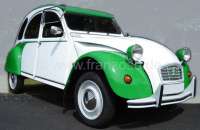
There were a total of three series of the 2CV Dolly, each distinguished by its characteristic two-tone paint schemes and color-coordinated adhesive lettering. The separation of the colors was emphasized by a wraparound decorative strip.
Here are the color combinations of the three series in detail:
This series was limited to 3,000 units and is recognizable by its highly contrasting color combinations:
Due to its great success, the Dolly was permanently added to the lineup. The gray-white variant of the 1st series was replaced by new colors:
In the final production phase, the colors became slightly more subdued and elegant:
The “Dolly” lettering appeared on all models as a sticker on the ventilation flap below the windshield and, in most cases, on the tailgate. The rims were uniformly painted white (Meije White) on almost all models to emphasize the playful look.
The eco-friendly special editions of the 2CV are available in green, green, and green.
In the 1980s, a phenomenon preoccupied the German nation that even found its way into the vocabulary of the French media as “Le Waldsterben.” The federal government established guidelines for improved environmental compatibility of passenger cars, as automobile exhaust fumes contributed significantly to so-called acid rain. As part of these measures, a change in vehicle taxation also took place in Germany in 1985.
Under the regulations at the time, new cars classified as “low-emission” or “conditionally low-emission” were exempt from vehicle tax for a period of three and a half years. Citroën achieved considerable success with the 2CV: By adjusting the compression ratio, the 2CV was modified so that it could run on regular unleaded gasoline and was also classified as “conditionally low-emission.”
At the 1985 International Motor Show (IAA), Citroën Germany presented a special edition model in its signature green color. Limited to 1,500 units, the Eco-2CV was adorned on the sides with a curved decorative strip. A slogan in classic “Denglish” proclaimed the message “I fly lead-free.”
In early 1987, another German special edition model in “Vert Bambou” was launched. The “Sausss-Ente,” limited to 2,000 units, was a humorous statement against the automotive obsession with performance. On the tailgate was a sticker with the self-deprecating message: “From 0 to 100 in 59.4 seconds.”
We still offer these eco-friendly decals—directly from the original manufacturer, who also supplied Citroën back then.
James Bond, Bastian, and R.E.M.—the 2CV in film, TV, and music videos.
When it comes to the 2CV and film, many people immediately think of Sister Clotilde, who drove the 2CV as a running gag through the Gendarme films starring Louis de Funès starting in 1964. In 1981, Roger Moore as James Bond took the 2CV on a high-speed drive through narrow coastal roads in southern France in “For Your Eyes Only”—not exactly gentle on the car.
The 2CV is particularly present in classic French cinema, away from the mainstream. As early as 1954, in Henri-Georges Clouzot’s crime thriller “The Devils,” the alleged murder victim is disposed of in a 2CV. In Louis Malle’s 1958 film “The Lovers,” Jeanne Moreau and Jean-Marc Bory escape their former bourgeois lives in a Citroën 2CV.
Claude Chabrol featured the 2CV in two films: the 1970 crime thriller “The Butcher” and, 25 years later, the drama “Beasts.” In 1973, George Lucas’s “American Graffiti” was one of the few films in which the 2CV appeared in American cinema.
The 2CV is rather rare in German cinema. Notable examples include Franz Peter Wirth’s “Confessions of a Furnished Gentleman” from 1962. Unforgettable examples on German television are the series “Der Bastian” from 1973 and “Unser Lehrer Dr. Specht,” which aired from 1991 to 1999. Even in the 2020s, the “Bundschuh Family” on ZDF still drives a red 2CV.
The Citroën 2CV also appears in music videos, for example in 1996 in “Bittersweet Me” by R.E.M., in 2004 in “Die perfekte Welle” by Juli, and in 2013 in the video for “Mind Mischief” by Tame Impala.
Here are the most famous models, listed in order of release:
Some models were designed exclusively by Citroën Germany with their own decal sets:


 PDF FILE
  Select your Citroen


 Please select your Peugeot


 Please select your Citroen Renault