Citroën 2CV Hood and Radiator Grill from 1960 Onward
On December 12, 1960, the era of the corrugated metal hood came to an end—a clear change in the Citroën 2CV’s appearance.
On this day, the new hood with a removable aluminum grille was installed for the first time at the Levallois-Perret plant—a small but effective change.
Technical Details
This facelift remained the only major visual overhaul during the 42 years of production (1948 to 1990), demonstrating the durability of the basic design.
However, the AZU (2CV delivery van) did not receive the new hood until July 1961 and retained its corrugated metal hood until then.
Under the new hood, everything remains the same, as the 12-horsepower engine with 28 Newton-meters of torque has remained unchanged since 1954. A technical upgrade would have been sensible, however.
Although the new Renault 4 was considered a direct competitor, Citroën remained cautious with its model updates. It wasn’t until September 1962 that Citroën began offering an electric windshield wiper as standard equipment.
Why was the front of the Citroën 2CV changed?
The new hood can be manufactured more quickly, which significantly reduces production time and thus costs. Since the triangular panels are now mounted individually, the hood is also easier to stack.
The trade-off, however, is reduced strength—a weakness that André Costa, editor-in-chief of “L’Auto-Journal,” demonstrated to an audience by effortlessly folding a hood down to the size of a towel.
Citroën 2CV Radiator Grill: Development and Versions
The history of the Citroën 2CV (“Tin Snail”) is clearly reflected in the evolution of its radiator grille. Over its 42-year production run, there were five main variants.
Chronology of Radiator Grille Versions
- The Oval (1949 – February 1953): The first models featured a distinctive oval frame around the Citroën chevrons (double chevrons), which were mounted directly on the grille.
- Large chevrons without a frame (March 1953 – November 1960): The oval ornament disappeared. Only the now significantly larger double chevrons remained.
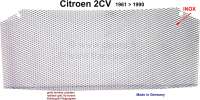
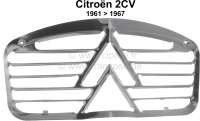
- Integrated small grille (December 1960 – August 1965): With the introduction of the new, five-ribbed hood, the design changed fundamentally. The grille became smaller and was made of aluminum. The new grille was bolted into the new hood for the first time.
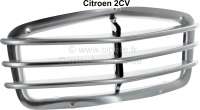
- Three horizontal bars (September 1965 – August 1974): This aluminum grille consists of three horizontal slats. A key distinguishing feature: The double-V emblems moved from the grille up onto the hood.
- Plastic grille (September 1974 – July 1990): The final grille type on standard 2CVs was made of gray plastic with a gray plastic trim. The double chevrons moved back to the center of the grille. All Charleston 2CVs had a gray grille with a black plastic trim. The popular plastic grilles with chrome trim were always optional accessories and could be ordered directly from Citroën at the Citroën dealership. However, there was never a 2CV that was delivered from the factory with a grille featuring a chrome trim.
At least in Germany, it can be said that in the 1980s, nearly every other new 2CV was retrofitted with a chrome-trimmed grille directly at the Citroën dealership.
Compatibility of Citroën 2CV Radiator Grilles
All 2CVs manufactured from 1961 onward can be retrofitted with various radiator grilles—whether metal or plastic. The mounting points have always been the same.
Of course, we also carry all these radiator grilles in various grades in our product range.





 VIDEO
VIDEO  Select your Citroen


 Please select your Peugeot


 Please select your Citroen Renault