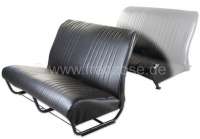
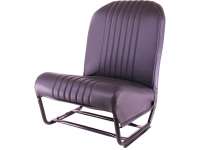
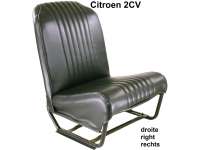
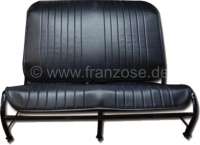
2CV, Seat bench cover rear. Vinyl black. The sides are closed. The surface is perforated (pierced
sample). Made in France.


sample). Made in France.
The most distinctive feature of the 2CV rear seat is its original purpose: it was not intended as a permanently installed piece of comfort furniture, but rather as a lightweight, removable utility seat. Citroën even played on this very idea in the 1960s: the bench or seats could be easily removed and taken along for a picnic or “to get some fresh air.”
Technically, the bench consists essentially of a tubular frame to which the upholstery or covering is attached. Early 2CVs still had very simple fastenings using hooks and straps. Starting in October 1954, the system was simplified: instead of flat rings and double hooks, round rubber rings with metal hooks were used, which were stretched between the frame and a sewn-in metal rod in the upholstery.
The seats underwent several changes over the course of 2CV production from 1949 to 1990. Notable differences include, for example:
In practice, this means: The rear bench can be easily removed. This is precisely one of the 2CV’s best features. In less than a minute, it turns into a comfortable picnic bench for the grass.
Reach behind the backrest. There, at the bottom center (or on the sides for newer models), you’ll find locking latches that secure the backrest to the body. Pull these upward or toward the center to release the backrest.
Fold the entire bench forward slightly.
The bench is not bolted to the floor but is hooked into the bench box with two hook-shaped feet. Lift the bench at an angle of about 45 degrees and pull it backward out of the hooks.
Now you can carry the entire bench outside through the rear door or the tailgate.
During installation, the two hooks on the underside must be securely hooked into the seat box before you lock the backrest. Otherwise, the bench may slide forward during the first braking maneuver.


 Select your Citroen


 Please select your Peugeot


 Please select your Citroen Renault