2CV old, exhaust pipe under the fender in front on the left. Suitable for Citroen 2CV4 old, AZU to
07/1972. (16hp). Or.Nr.: AZ18299


07/1972. (16hp). Or.Nr.: AZ18299
1972. Clamping range to about 36mm. Or.Nr.AZ18380
about 28mm. Or.Nr.AZ18380A
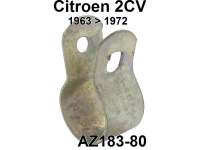
18hp). The clip half is required 2x. Or.Nr.: A183-79
exhaust pipe is mounted on the right, and is diagonally under the trunk floor and ends on the left side!
Or.Nr.AZ18263. Made in Germany.
d inlet, flattened outlet. Unfortunately, the rear silencer is a bit louder than the original! That's not nice, but unfortunately we haven't found any better ones yet.
Round inlet, flattened outlet. Unfortunately, the rear silencer is a bit louder than the original! That's not nice, but unfortunately we haven't found any better ones yet.
30,0mm. Good reproduction. Or.Nr.AZ183-1A
reproduction. Or.Nr.: AZ 183-1
right side mounted exhaust! Or. No. AK182-4
locked under the floor pan. Suitable for Citroen 2CV6 + 2CV4. Made in Germany.
locked under the floor pan. Note: Connector with 6mm screws! Suitable for Citroen 2CV6 + 2CV4. Made in Germany.
the floor pan. Suitable for Citroen 2CV6 + 2CV4. Dyane, AK
floor pan. Suitable for Citroen 2CV6 + 2CV4.
pan. Suitable for Citroen 2CV6 + 2CV4. Made in Germany.
Suitable for Citroen 2CV6 + 2CV4.
until 1969, AMI6. 1x round inlet, 1x round outlet. Or.Nr.: AK1821A
typical trim from the fifties + sixties. Total length: 135mm.
compound hardens when heated. Very helpful!
nuts: no rust, no sticking!
Every internal combustion engine produces a characteristic “exhaust note” due to the pulsating gas flow from the cylinders. To achieve this, it is necessary to reduce the sound energy of the exhaust gas flow. There are two ways to reduce noise: absorption and reflection. These processes primarily take place in a muffler.
Apart from its sound-dampening function, the exhaust system is also exposed to extreme conditions. The fuel-air mixture in the cylinders heats up suddenly to as high as 2,400 °C. As a result, the gas expands and shoots into the exhaust system at supersonic speeds. This produces explosion-like banging noises, which must be reduced by 50 dB(A) from the engine exhaust valve to the end of the exhaust system.
In addition to these temperature and pressure stresses, the exhaust system must absorb vibrations and oscillations originating from the road surface. Furthermore, the exhaust is exposed to corrosion from hot exhaust gases, acids, splashing water, and salt water.
There are two different versions of the exhaust systems for the Citroën 2CV with 375 cm³ and 425 cm³ engines. Each consists of two components (mufflers). The 2CV, which was built between 1950 and 1963 (models AZ, AZL, and AZAM), had an exhaust with an inner diameter of 26 mm.
Starting in 1963, the system was changed to an exhaust with a 30 mm inner diameter (models from 1963 to 1972, types AZL and AZAM).
Both of these exhaust variants had their exhaust outlet located below the engine-transmission unit. This exhaust outlet sometimes led to significant exhaust fumes entering the passenger compartment if the exhaust was not properly sealed. Exhaust fumes particularly penetrated the passenger compartment as traffic in cities became heavier, since there was no airflow to blow the exhaust fumes away.
This exhaust system was also used on the Fourgonnette (a small van based on the 2CV) from these model years.
In the 1960s, however, there were already a few exhaust systems that were more complex in design. For example, there were right-side exhaust systems with exhaust pipes sometimes routed horizontally under the vehicle so that the exhaust gases could exit at the rear left.
We carry all of these different exhaust systems in our product range. This includes the rarely requested right-side exhaust systems. The AMI6 also had a unique exhaust layout, which we carry in our product range.
With the introduction of a new generation of engines with 435 cm³ (2CV4) and 602 cm³ (2CV6) displacement, there was also a switch to an exhaust system consisting of four individual parts (2x mufflers + 2x exhaust pipes). This is mounted on the left side of the vehicle, with the exhaust outlet at the rear left under the rear bumper.
For the 2CV6, we also offer a stainless steel exhaust system.


 Select your Citroen


 Please select your Peugeot


 Please select your Citroen Renault