tires and rims for Citroën 2CV ACDY
36 Articles


Wheel 4Jx15 for 2CV (tubeless), original size. Attention: The production of these rims has been
discontinued by Citroen. However, the rims are being reproduced close-to-series. The rims are 100% close-to-series in terms of material, all dimensions and the surface coating and correspond to the original equipment standard. We are often asked what a close-to-series rim is. This means that the rim is manufactured by the same factory, on the same machine and with the same materials as the original Citroen rim. The only difference is that Citroen is not the customer. The rim is therefore also approved by the Federal Motor Transport Authority. The wheel basically consists of a rim and a disc. The rim is made from strips that are butt-welded together. The so-called bandage then goes into the rolling operation (normally 2 rolling operations). The disc is then pressed into the rim in the appropriate position. This is known as the press fit. This serves as a fixation for the subsequent welding operation, which is carried out by spot welding. Finally, the entire wheel is coated with a cathodic dip coating to protect it against corrosion and the front is primed in greyish beige. KTL itself is the rust protection. The grey-beige primer is not a final coat. For an optimum appearance, the rims should be painted again. With the reproduction rims known to us, the disc is not pressed in, but only inserted and then welded. (weld seams). These rims therefore have no so-called press fit. But the press fit is what gives the entire wheel its strength. As it is extremely expensive to remanufacture a wheel with a press fit, savings are made on this. That's why our rims are a little more expensive, but your safety should be worth it. Because only the wheel with the tyre makes contact with the road. The rim is for tubeless use, but you can also ride it with a tube!
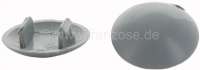
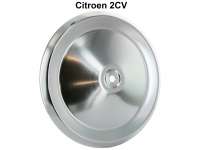

Rim cap from synthetic. Color grey. Suitable for Citroen 2CV (for plugging the angular hole in the
center from the 2CV rim).
Rims chrome ring (4 fittings) from high-grade steel, for rim 15 ", suitable for Citroen 2CV. They
are pressed only into the rim well!
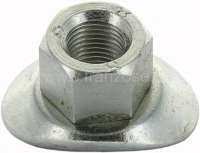
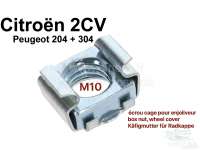
Box nut suitable for the securement of the wheel cover, for Citroen 2CV, Peugeot 204 + 304. The box
nut is pressed from the rear into the rim! Thread M10.
Wheel cover from polished high-grade steel. Suitable for Citroen 2CV. The wheel cover looks like
the original Citroen wheel cover. Or.Nr. AY8541
 PDF FILE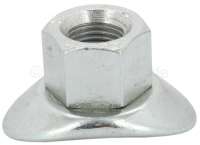
Wheel cover polished, from high-grade steel. The wheel cover have a different design than the
original wheel covers. Suitable for Citroen 2CV. "The blue protective coating is very easy to peel off with hot water!
Wheel cover set completely for 4 rims. Suitable for Citroen 2CV. Consisting of: 4 wheel cover
(original shape). 4 wheel cover screw from high-grade steel. 4x box nut. Only sutiable with short wheel nuts.
Wheel cover set completely, consisting of 4x wheel covers, 4x wheel cover screw, 4 x box nut)
Suitable for Citroen 2CV. Note: The wheel covers can only fit, if you have short wheel nuts!
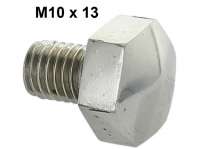
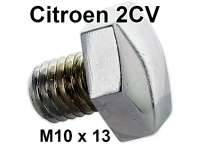
Wheel cover screw from high-grade steel, for Citroen 2CV. Original Citroen. Better treats with than
our No. 16812. Thread M 10 x 13mm, for wrench 19mm.
Wheel cover screw washer from synthetic, M10, for Citroen 2CV. These disks were in former times
original under the screw and prevent scratches and contact corrosion! Per piece.
Wheel nut short, galvanizes, for 2CV, Dyane, Mehari, AMI, GS, DS. Peugeot 403, 404, 204, 304, 504
505. Thread: M12x1,25. Lubricate before mounting. Original supplier! Been suitable to torque: 130Nm
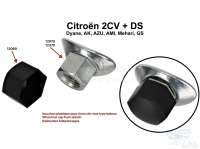
Wheel nut short, galvanized, suitable for Citroen 2CV, Dyane, Mehari, AMI. Measurement: M12 x 1,25
Is suitable up to 45 NM torque (2CV). Please lubrify before mounting. Replica
Wheel nut long, galvanizes, suitable for Citroen 2CV. Measurement: M12 x 1,25. Tightening torque
40-50 nm. Caution: hub caps cannot be used with short wheel nut`s!
The brake-down aid for on the road. SONAX TyreFix restores driveability to flat tyres, without tyre
change. Seals small holes in the tyre and pumps it up. Practical, fast and safe. 400ml
Tire 135/15 with 20mm white wall. Manufacturer Michelin. The white wall is later up-vulcanizes
Delivery time about 2-4 weeks.
Tire (reproduction) mounts on a new rim, R125/15. The Vee tire resembles optical the Michelin
profile. We use only our own, series-identical rims and no reproduction rims! Suitable for Citroen 2CV.
Tire mounts on a new rim, R135/15. Manufacturer Michelin. We use only our own, series-identical
rims and no reproduction rims! Suitable for Citroen 2CV, AK, Dyane, AMI.
Tire R135/15 ZX. Manufacturer Michelin. Summer tire. Suitable for Citroen 2CV, AK, AMI, Mehari
Renault Caravelle, Renault 4CV, R8, R10, Dauphine Ondine
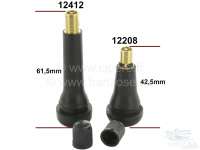
Valve (rubber valve) for rim. Suitable for Citroen 2CV, DS, CX, HY, GS. Renault R4, R5, R6, R8
R10, rear engine. Peugeot 203, 403, 404, 504, 604, 204, 304, J7. For valve hole: 11,3mm. Length: 42,5mm.
Valve long (rubber valve) for rim. To uses this long valve, if the rim has a large wheel cover
(with cutout for the valve). Suitable for Citroen DS, CX, HY, GS. Renault R4, R5, R6, R8, R10, rear engine. Peugeot 203, 403, 404, 504, 604, 204, 304, J7. For valve hole: 11,3mm. Length: 61,5mm.
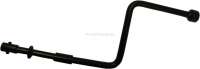
lifting jack like original. Suitable for Dyane, Acadyane, Mehari. Note: without crank. The crank is
to be received under the article number 20060.
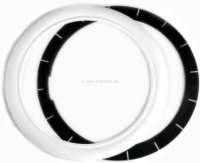
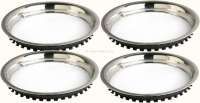
White wall rings, 4 fittings. Suitable for Citroen 2CV. Note: The white wall rings can be mounted
only in combination with our rims chrome rings 16815!
Winter tire 135R15MS. Manufacturer Michelin. Suitable for Citroen 2CV. Also very well as
all-terrain tires for Citroen Mehari.
Winter tire mounts on a new rim, 135/15. Manufacturer Michelin. We use only our own
series-identical rims and no reproduction rims! Suitable for Citroen 2CV.
36 Articles
Tires for the Citroën 2CV - Michelin X
Development of the Citroën 2CV began in France in the mid-1930s. At that time, the major tire manufacturer Michelin took over Citroën, which had significant debts to Michelin. Michelin remained the owner until 1976, when it sold the company to Peugeot (PSA).
Naturally, the new car, named the 2CV, was to be equipped with Michelin tires. Thus, in 1949, the 2CV was fitted with state-of-the-art Michelin radial tires, which were developed specifically for the 2CV. The technical advancement over the bias-ply tires common at the time was breathtaking.
Initially, the 2CV was delivered with 125 x 400 tires. This means the width was 125 mm and the inner diameter was 400 mm. The tire is correctly designated as 125x400 or also as Pilote 125x400.
This tire size was used until September 1959. The AU-type light commercial vehicles based on the 2CV (Fourgonnette, Kastenente) also had tires with an inner diameter of 400 mm. However, the tire width was 135 mm (135 x 400, 135x400, 135/400, Pilote 135 x 400), making it 10 mm wider than the 2CV sedan tires, which are 125 mm wide.
Starting in September 1959, Michelin adopted the standard wheel size classification used by nearly all manufacturers and switched to 15-inch tires. The inner diameter was now 380 mm. The tire width of 125 mm was retained. Naturally, this also required a change to the rim.
The 125/80/15 tire now in use was retained until production ended in 1990.
The following designations are common for the 125 mm tire: 125 x 15, 125x15, 125R15, SR125/15. Since the sidewall height is specified as a percentage of the tire width, the following designations are also common: 125/80R15, SR 125/80R15, or 125/80/15 and 125/80 R15.
The tire sidewall is therefore 100 mm high (80% of the tire width 125 mm = 100 mm).
The 2CV van (AZU, AK, AKS, Kastenente) has always had a higher payload capacity than the 2CV sedan. For this reason, it retained the 10 mm wider tires, which have a higher load capacity. But now also in the 15-inch version (135/80R15, 135/80 R15). The tire sidewall is therefore 108 mm high (80% of 135 mm is 108 mm).
As a result, the rolling circumference of the 135/15 (135/80R15) tires is slightly greater than that of the 125/15 (125/80R15) tires.
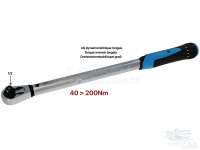
When changing the wheels on the 2CV, as well as on the Fougonette, the wheel nuts should be tightened to a torque of 45–50 Nm.
Wheel nuts must always be tightened dry.
The threads must not be lubricated beforehand (this is even prohibited by the German TÜV). Always use a torque wrench for checking. Because your safety depends on those narrow 125 mm tires!
1. The Era of 400-mm Wheels (1948–1959)
At launch and in the early years, the 2CV used wheels whose diameter was measured in millimeters.
- 125 R 400: The standard size for sedans (A, AU, AZ, AZL).
- 135 R 400: Wider size, reserved for the light commercial vehicles (AZU) and the 2CV Sahara.
- Tire models: Initially the Michelin “Pilote,” later the widespread introduction of the Michelin X with radial construction.
2. The Transition to 15-Inch Wheels (1959–1990)
In September 1959, Citroën introduced smaller 15-inch wheels (equivalent to 380 mm), which became the international standard.
- 125 R 15 (or 125 x 380): This is the iconic tire for the 2CV. It was used on nearly all sedans (2CV4, 2CV6, Spécial, Club, Charleston) until production ended in 1990.
- 135 R 15 (or 135 x 380): Used on heavier commercial vehicle versions such as the AK 350 and AKS 400, as well as on certain derivatives like the Ami 6 or the Méhari.
- Tire models: The Michelin X remains the absolute benchmark, although variants such as the Michelin ZX (more modern) or M+S tires (snow) were also offered.
Technical Overview
| Period | Model | Size | Michelin | Carcass Type |
|---|---|---|---|---|
| 1948–1959 | Sedan | 125 R 400 | Pilote / X | (Radial) |
| 1951–1959 | Light truck | 135 R 400 | Pilote / X | (Radial) |
| 1960–1990 | Sedan | 125 R 15 (125–380) | Michelin X / ZX | |
| 1960–1978 | Light truck | 135 R 15 (135–380) | Michelin X / ZX |
Important Tips
The main difference between the Michelin Pilote and the Michelin X lies in their basic construction—diagonal versus radial tires—and the corresponding era of automotive technology. While the Michelin X is the classic tire for the 2CV, the Pilote represented a transitional technology for the first 2CV vehicles.
The Michelin Pilote dates back to the 1930s/40s and was primarily developed for the Citroën Traction Avant (11 CV/15 CV).
Technology: The original Pilote tire was a cross-ply tire, but featured a wider tread on smaller rims—a design that was advanced for its time.
That is why Michelin also used it for the 2CV in the early years. Since the switch from the Pilote tire, the Michelin X has been the standard for the 2CV and is inextricably linked to the Citroën 2CV.
Technology: The Michelin X tire was the world’s first mass-produced radial tire (belted tire)!
Handling: The radial construction separates the functions of the sidewall (suspension/comfort) from the tread (traction). This ensures significantly more stable road holding, more precise steering, and a longer service life compared to older bias-ply tires.
Given the narrow tires and low air volume, regular checks are essential, as even minimal pressure loss can significantly affect handling.
Tire pressure for Citroën A-series models (2CV, Dyane, Ami, Méhari) varies depending on the model and load, but follows a proven pattern for standard tires in sizes 125 R 15 or 135 R 15.
Here are the standard values for the most important models:
Standard values for passenger car models (sedans)
These values apply primarily to tire size 125 R 15:
- Front: 1.4 bar (approx. 20 PSI)
- Rear: 1.8 bar (approx. 26 PSI)
Note: When fully loaded or driving on the highway, the rear pressure is often increased to 2.0 bar.
Pay close attention to tire pressure. Many repair shops set the pressure to at least 2 bar (because other vehicles require this). However, with 2CV tires, this reduces driving comfort.
The tire’s tread cannot adapt to the road surface in fast corners, and the tire has to flex much more. This causes the tire to heat up extremely and can even lead to a blowout. Tread wear is much higher when tire pressure is too high (the tread in the center of the tire wears down very quickly).
Citroën Dyane & Méhari:
The recommended tire pressures are as follows:
- Front: 1.4 bar
- Rear: 1.8 bar (up to 2.0 bar when loaded)
For the Ami 6/Ami 8, the values are slightly higher due to the greater weight and wider tires (135 R 15):
- Front: 1.5 bar
- Rear: 1.8 bar (up to 2.2 bar for the Break/Kombi when loaded)
The following values are recommended for panel vans (Fourgonnettes):
Models such as the AK 350, AK 400, or the Acadiane require significantly higher rear pressure:
- Front: 1.5 bar
- Rear (unloaded): 1.8 bar
- Rear (loaded): 2.5 bar to 2.8 bar
We recommend keeping the spare tire at the highest pressure (approx. 2.5 bar) to be prepared for any situation in an emergency.
However, we offer significantly more affordable tires for the 2CV. These have a similar tread pattern to Michelin’s X tire.
What to keep in mind when new tires need to be installed:
The 15-inch diameter rim (380 mm) is designed for tubeless installation (but you can also install a tube if desired).
But very important: Once the tire is mounted, it should first be inflated to 3.5 bar and left to rest for at least 24 hours. This allows the tire rubber to conform to the rim flange. Afterward, adjust to the correct tire pressure. Rims with new tires can be balanced. However, very few companies still have suitable adapters for the 3-hole rim to fit the balancing machine.
For your safety, we still carry the original Michelin tires with a width of 125 mm (our item number 12081), as well as the 135 mm wide tires. We also carry a type of all-terrain tire from Michelin that can be used as a winter tire.
Michelin still produces these tires for the 2CV with the original tread design. However, the tire compound has changed due to EU regulations (ban on rubber plasticizers). As a result, they are not quite as resistant to tire “aging” as the earlier tires (the tires should be replaced every 10 years, as they develop sidewall cracks), but the mileage remains extremely high.
It’s just that 2CVs don’t reach those high mileage figures anymore.
We also offer an affordable alternative featuring the Michelin tire design. This tire even has a sidewall reinforcement strip.
Of course, we also offer fully mounted tires for the 2CV on new, TÜV-approved rims. The Michelin 125/15 R15 tire is also available as a whitewall tire.
The Development History of 2CV Rims
The rims of the Citroën 2CV are almost as iconic as the car itself. Their development reflects the journey from spartan post-war construction toward greater safety and more modern tires.
This history can be divided into four distinct phases:
The "Four-Hole" Era (Prototypes & Pre-Production)
Very early prototypes (TPV) had four wheel bolts. For the production series, this was reduced to the famous three bolts for the sake of simplicity.
The narrow 400-series rim (1948 – ca. 1960)
Dimensions: 125 x 400 (millimeter measurement!).
Appearance: They look very large and narrow. These rims were designed for tubed tires.
Special feature: The wheel nut sockets were flat, not conical.
The switch to 15 inches (from ca. 1960)
Citroën switched to the standard 15-inch size (equivalent to approx. 380 mm). The standard width was initially 3.50 x 15 (for 125 tires) and later 4.00 x 15 (for 125 and 135 tires on the Ami 6/8 and Dyane).
Until around 1967, the rims had a large center hole to center them on the wheel balancer.
The closed rim (from 1967)
The center hole disappeared (the rim is now "blind" in the center). Balancing these rims still requires a special adapter that secures the rim via the three bolt holes.
You must pay special attention to this
Tire selection (radial vs. bias-ply)
The 2CV was designed for the Michelin X (radial tire). Never use bias-ply tires on a 2CV; the handling becomes dangerously spongy.
Standard size 2CV
125 R 15.
Standard size for Dyane/Ami
135 R 15 (also fits the 2CV, but makes it a bit sluggish).
Tubeless or tube? (Tubeless check)
400 mm rims require a tube. 15-inch (380 mm) rims can be used tubeless.
Tightening torque
Moderate! About 40–60 Nm is plenty. If you tighten them to 120 Nm like on a modern car, you’ll warp the thin rims.
Rust in the rim flange
2CV rims consist of two parts that are riveted or welded together. Rust often forms in this gap, causing the rim to "bulge." If you see severe rust blisters there, the rim is scrap.
Tip: Apply grease to the joint (seam) between the two rim parts (on the back of the rim).
Paint
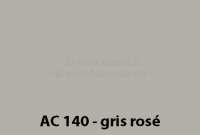
The correct color for almost all model years is AC 140 (Gris Rosé). Early models were often painted in the body color or a darker gray.
 Select your Citroen


 Please select your Peugeot


 Please select your Citroen Renault