Rubber cap for the connection at the generator. (Protecting cap). This cap should never be missing
Universal fitting! For max. cable diameters: 7,62mm. Inside diameter 12,7mm.


Universal fitting! For max. cable diameters: 7,62mm. Inside diameter 12,7mm.
Citroen 2CV, Dyane, Mehari, Installed to year of construction 1990. No old part return necessarily!!
Mehari, Installed to year of construction 1990. No old part return necessarily!!
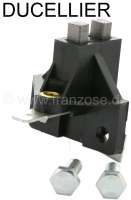
15. FLD= DF at generator (connection at the brush). Ground on case! Optically very nice. Dimension case: 64mm x 40mm. Overall height: 56mm. Dimension screwed joint sub-base: 83mm x 83mm. Screwed joint distance (slotted holes) from 60 to 70mm.
02/1970 to 1990). The charge regulator replaces the original electromechanical alternator regulator. It is attached to the battery in exactly the same way and the 3-pin plug also fits. Conversion time: less than 60 seconds! The charge regulator also fits the following Citroën models: Dyane (from year of construction 08/1967 > 10/1984). Méhari (all 12-volt versions). Ami8 (all 12-volt versions). Citroën CX 1 (MA) from year of construction 09/1974 > 08/1985. GS from year of construction 09/1970 > 07/1986. LNA + Visa from year of construction 11/1976 > 03/1991.
(voltage regulation on 15,3 V). Connection: 2x plug-in connection. As substitute for control devices without 3 connection plug! Connections: Clamp 15 = electric current + over starter lock. Clamp 67 = EXC, or DF. Earth - (31) over the securement at the body.
construction 1990. This handle can be stuck on the battery, or at the engine front wall (fire wall) screwed. Made in Germany.
Ground on housing. Substitute Ducellier. Maximum 360 Watts! 30 ampere. Was away mounting holes: 125mm. Manufacturer: Bosch
Measurements of 7,9x22mm. File on measure and remove a cable.
crankshaft. Installed one starting from 1954. Measurements: 15x7mm.
Femsa Generator Brush Set is also partial in Citroen GS, CX + LN Installed.
Length: 19mm. Thickness: 5mm. Height: 7mm.
An alternator is an electrical generator, usually designed as a three-phase generator, that is driven by the internal combustion engine. It supplies power to the vehicle’s electrical systems and the starter battery.
The name “alternator” comes from the fact that the generator originally supplied power only to the vehicle’s lighting system. The magneto ignition system, which was common at the time, was independent of this, as it operated without an external power supply.
In the past, the engine was started with a crank, so there were no starters that required electricity.
Incidentally, nearly all French vehicles built up until the 1970s can still be started with a hand crank!
The Citroën 2CV could even be started this way until the 1990 model year. But the Citroën DS could also be started with a crank throughout its entire production run. The same applies to the Renault R4 and the Peugeot 203, 403, and 404.
There are a few other names for the power generator, such as alternator, generator, or dynamo. In Switzerland and in Slavic-speaking regions, the power generator is called a dynamo. In automotive engineering, it is correctly referred to as a generator. In common usage, however, the term “light machine” has become established.
Please note that the generator’s energy is required by both the engine and numerous safety and comfort systems. Furthermore, it is essential that the generator has sufficient power capacity to ensure reliable battery charging.
Typically, the generator is driven by the engine via a V-belt.
In the Citroën 2CV, however, the alternator was mounted directly at the front of the engine until the 06/1967 model year and was driven directly by the crankshaft via a rigid connection.
Starting in July 1967, the design was changed to an alternator mounted on top of the exhaust manifold. These alternators were then also driven by a V-belt.
The operating principle of an alternator is based on electromagnetic induction.
This means: When an electrical conductor moves through a magnetic field, an electrical voltage is generated in the conductor. It does not matter whether the magnetic field or the conductor is moving.
The main components of the alternator are:
The rotor generates the magnetic field. The strength of the magnetic field depends on the current flowing through the rotor. Regulation is performed by the regulator. As soon as the rotor begins to rotate, an alternating voltage is generated in the stator windings. This is converted into a direct voltage by the diodes of the rectifier before it enters the vehicle electrical system.
In current practice, the use of a three-phase generator, also known as an AC alternator, has become standard.
However, DC generators were still very commonly installed until the mid-1970s. Since DC alternators had to be built very robustly (and were therefore very heavy) and their current output depended heavily on engine speed, the switch was made to three-phase alternators. Their advantages include a compact design, low weight, and high current output even at low speeds.
We also offer three-phase alternators that look just like the old DC generators. Yet they often weigh only one-third as much as the original DC generators!
Generators today are maintenance-free units. To ensure they can perform their function throughout the vehicle’s entire service life, the condition and tension of the drive belt (V-belt) must be checked regularly. This is done as part of the maintenance intervals prescribed by the vehicle manufacturer. If the drive belt is cracked and worn, it must be replaced immediately.
However, if your classic car still has an original alternator (DC generator) from the 1960s, 1950s, or even earlier, its bearings must also be oiled regularly.




 Select your Citroen


 Please select your Peugeot


 Please select your Citroen Renault