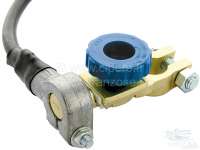
Starter relay, mounted at the positive terminal of the battery. With 90cm cable. Suitable for
Citroen DS (with left mounted battery) + Citroen HY. Or. No. 2D5401570T


Citroen DS (with left mounted battery) + Citroen HY. Or. No. 2D5401570T
for many Peugeot + Renault vehicles. Reproduction like original!
12 volts. This small continuous charger is ideal for permanently connecting to a battery during the winter break. State-of-the-art technology protects against reverse polarity of the connections. It is suitable for normal lead batteries (those with acid). The maximum charging current is 0.6 amps. Please note: You cannot use this charger to quickly charge or reactivate empty batteries! It is therefore designed to keep the battery fresh and, if necessary, charge it very slowly. The scope of delivery also includes a charging cable that can be permanently connected to the battery. Simply route the plug connection to the outside and the charger can be connected without opening the bonnet.
knife' among battery chargers. You can connect all types of batteries (STD, AGM, EFB, GEL batteries). Almost all sizes can also be connected (3AH > 144Ah). This charger can even reactivate deeply discharged batteries (down to a discharge of 0.5 volts)! Its smart electronics make it possible. You can also test batteries. It has a safety circuit in case it is connected incorrectly. It controls the charging current according to the ambient temperature and has many other options. Whether it's a lawnmower, boat, car, motorhome, motorbike or tractor, this charger automatically adjusts to everything. And let's be honest, who knows what kind of battery is installed in modern vehicles these days? With this, it doesn't matter! Only modern electric vehicles cannot be charged with it! Of course, it can also be used as a normal battery maintenance charger. Our tip if you have several vehicles that are stored over the winter: get one of these chargers and equip the other vehicles with our maintenance chargers. The scope of delivery also includes a charging cable that can be permanently connected to the battery. Simply route the plug connection to the outside and the charger can be connected without opening the bonnet. Regular desulphation is important for a long service life of lead-acid batteries. And this is what these modern chargers can do.
4 amps at 6 volts. This battery charger and trickle charger only charges lead-acid batteries (i.e. the batteries in classic cars). It can be used for both 6 volt and 12 volt batteries. This charger can also reactivate deeply discharged batteries (up to a discharge of 0.5 volts)! The clever electronics make it possible. You can also test batteries. It has a fuse circuit in case it is connected incorrectly. It controls the charging current according to the ambient temperature and has many other options. Regular desulphation is important for a long battery service life. And this is what these modern chargers can do.
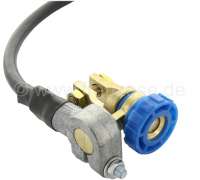
can be very easily used when you do not use your car for long time(winter)! This switch replaces battery negative pole lead!
used when you do not use your car for long time(winter)! This switch replaces battery negative pole lead!
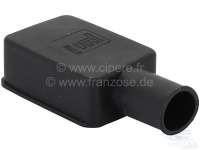
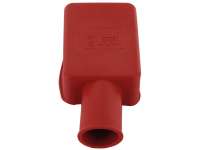
of mixing up the terminals when connecting the battery is now minimised. These coloured battery terminal connectors are suitable for cables with a maximum diameter of 12 mm (cable cross-section up to 113 mm²). They fit terminal sizes of 16-19 mm. They are suitable for 6 V and 12 V batteries. And they look great too! Made in Germany. Designed for DIN A cone terminals with the following diameters: Positive terminal: 19.5 mm at the base of the cone, 17.5 mm at the top of the cone. Negative terminal: 17.9 mm at the base of the cone, 15.9 mm at the top of the cone. The positive terminal is therefore always larger than the negative terminal! The DIN A cone terminal is the standard connection used in Europe for lead-acid car batteries.
terminal: 19.5 mm at the base of the cone, 17.5 mm at the top of the cone. Negative terminal: 17.9 mm at the base of the cone, 15.9 mm at the top of the cone. The positive terminal is therefore always larger than the negative terminal! The DIN A cone terminal is the standard connection used in Europe for lead-acid car batteries.
terminal: 19.5 mm at the base of the cone, 17.5 mm at the top of the cone. Negative terminal: 17.9 mm at the base of the cone, 15.9 mm at the top of the cone. The positive terminal is therefore always larger than the negative terminal! The DIN A cone terminal is the standard connection used in Europe for lead-acid car batteries.
Designed for DIN A cone terminals with the following diameters: Positive terminal: 19.5 mm at the base of the cone, 17.5 mm at the top of the cone. Negative terminal: 17.9 mm at the base of the cone, 15.9 mm at the top of the cone. The positive terminal is therefore always larger than the negative terminal! The DIN A cone terminal is the standard connection used in Europe for lead-acid car batteries.
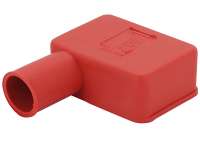
right - cable inlet down.
electrical contact is back in order.
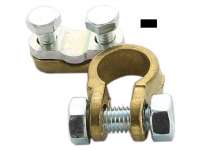
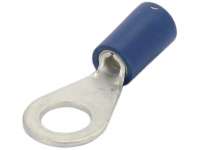
diameter: 22mm ². Made in the European Union. Universal fitting.
in the European Union. Universal fitting.
diameter: 22mm ². Made in the European Union. Universal fitting.
diameter: 22mm ². Made in the European Union. Universal fitting.
diameter: 22mm ². Made in the European Union. Universal fitting.
diameter: 22mm ². Made in the European Union. Universal fitting.
the European Union. Universal fitting.
If a car isn’t driven for an extended period, the car battery can discharge. There are physical and technical reasons for this. Sulfation, incomplete charging, and leakage current play a particularly important role in classic cars.
Desulfation is a process for regenerating lead-acid batteries, typically classic car batteries. The goal is to restore the capacity of a battery that has been reduced by deposits of lead sulfate crystals.
That is why it is important to distinguish carefully when selecting a battery charger: does the device merely charge and maintain the battery, or does it also feature a desulfation function? Even regular trickle charging can significantly extend the service life of a classic car battery.
We offer three different chargers for classic cars and vintage vehicles:
As a general rule, whenever a battery is discharging, you should always check for leakage current.
Leakage current is a common problem in classic cars and is often the reason why the battery is already dead after just a short period of inactivity. While modern vehicles require a certain amount of standby current for control units, unwanted current losses in classic vehicles are usually caused by aging, moisture, or dirty electrical connections.
If the fault cannot be found despite blown fuses, the cause often lies in unprotected components such as the alternator or starter motor. In this case, the only effective solution is usually to disconnect these components specifically for testing.

 Select your Citroen


 Please select your Peugeot


 Please select your Citroen Renault