Citroën 2CV6 602 cc Engine: Choosing the Right Parts
For the Citroën 2CV6, Dyane, Ami, AK, and other A-series models with a 602-cc engine, precise engine identification is particularly important. The specification “602 cm³” is not sufficient for a reliable selection of parts. Depending on the engine code, year of manufacture, and technical specifications, the crankshaft, camshaft, oil pump, pistons, cylinders, carburetor, ignition system, and oil circuit can vary significantly.
To ensure that replacement parts fit reliably and the engine runs smoothly in the long term, you should check the engine plate, the year of manufacture, and the specific technical configuration before selecting any parts.
Why not all 602 cm³ engines in the Citroën 2CV6 are the same
Citroën 602-cm³ engines were built in various versions. Well-known designations include M28, M28/1, AK2, AM2, A06/635, and A06/642. Although these engines belong to the same displacement class, not all components are interchangeable.
Significant differences exist, for example, in:
- Engine block and oil circuit
- Crankshaft and oil passages
- Pistons and cylinders
- Compression
- Carburetor and intake
- Ignition and ignition curve
- Oil filter design
- Cooling and air flow
Especially with older or previously overhauled engines, it is possible that different components have been combined over the years. Therefore, the existing configuration should always be checked directly on the engine.
The engine plate is one of the most important factors for selecting the correct parts. Therefore, first check which engine code is present on the engine. Common codes include, for example, M28, M28/1, AK2, AM2, A06/635, or A06/642.
A 602-cc engine can have different technical specifications depending on the version. For pistons, cylinders, camshaft, crankshaft, oil pump, carburetor, and engine gasket set, the exact engine code is often more important than the displacement alone.
Distinguishing Between Early and Late 602-cc Engines
An important difference lies in the oil filter design. Early M28 and M28/1 engines may be equipped without an external oil filter. Later engines, on the other hand, have an external oil filter and a correspondingly different oil supply system.
These differences affect not only the oil filter itself, but also the oil circuit, the crankshaft, the camshaft, and the oil pump. Therefore, early and late components should not be combined without verification.
Select a crankshaft that matches the engine block
The crankshaft must be compatible with the respective oil circuit version. Oil holes and lubrication vary depending on the version. An incompatible crankshaft can lead to insufficient lubrication and severe engine damage.
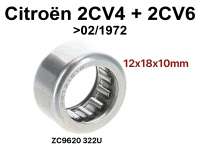
When replacing the crankshaft, you should also inspect the pilot or needle bearing on the flywheel side and replace it with a suitable one. The flywheel bolts should also not be reused, as these components are subjected to heavy loads.
Pistons, Cylinders, and Compression Ratio in the Citroën 2CV6 Engine
A compression ratio of 8.5:1 is common in many 2CV6, AK2, and A06 engines. This configuration is suitable for everyday use, is generally less prone to overheating, and is often the best choice for a stock-like engine setup.
Pistons and cylinders with a 9.0:1 compression ratio are more typical of higher-performance AM2-oriented configurations, such as those found in certain Dyane or Ami engines. This higher compression ratio can enable greater power output but requires appropriate overall tuning.
This includes:
- a suitable carburetor
- correct carburetor jet settings
- appropriate ignition
- proper cooling
- complete airflow
Higher compression should therefore not be considered in isolation. Only when all components work together will the engine operate reliably and durably.
Special Feature of the A06/642
A06/642 engines are a later model that is often designed for lower compression or an exhaust-oriented tuning. This engine version can also be combined with components from a 9.0:1 tuning. However, the carburetor jets must be adjusted accordingly!
When an A06/642 engine is to be overhauled or modified, compression, carburetor, ignition, and cooling must be considered together.
Camshaft, carburetor, and ignition must be compatible
The camshaft influences power, torque, idle behavior, ignition timing, and carburetor tuning.
Oil supply and cleaning during engine rebuild
When rebuilding an engine, the oil supply should be checked particularly carefully. The oil pump, oil passages, oil filter design, and engine block must be compatible.
For unknown or long-stored engines, the oil passages should be thoroughly cleaned and blown out. Old deposits can damage new bearings, the crankshaft, or other components. The oil filter should always be replaced when working on the oil circuit.
Cooling in the air-cooled 2CV engine
The air-cooled 602-cc boxer engine relies on a complete and correctly installed air intake system. Cooling fins, rubber seals, and air deflectors must not be missing or incorrectly installed.
Inadequate cooling can lead to overheating, loss of power, and long-term engine damage. Especially after engine work, you should check that all panels are properly seated and that the cooling air is flowing freely.
Do not confuse the M4, M28, 425 cc, and 435 cc
Not every older Citroën engine is compatible with the M28 or M28/1. The M4 is an older 602-cc generation and should not be combined with later M28 or M28/1 components without prior verification.
Likewise, 425-cc and 435-cc engines must not be confused with 602-cc engines. They differ significantly in bore, displacement, engine design, and many components.
Therefore, only compatible 602-cc components should be used for an M28 or M28/1 engine.
Production-based engine setup for daily use and durability
For a vehicle suitable for daily use, a production-based engine setup is often the most recommended solution. An 8.5:1 compression ratio with appropriate stock tuning offers, in many cases, a good combination of durability, drivability, and thermal safety.
A more powerful AM2-oriented engine can be a good option, but it should always be built as a coordinated overall concept. In this case, the compression ratio, carburetor, ignition, and cooling system must be compatible with one another.
Frequently Asked Questions About the Citroën 2CV6 602 cm³ Engine
Are all Citroën 602 cm³ engines the same?
No. The specification 602 cm³ alone is not sufficient to reliably select the right replacement parts. Depending on the engine code, year of manufacture, and model, the crankshaft, camshaft, oil pump, pistons, cylinders, carburetor, ignition, and oil circuit may differ.
How can you identify the correct 2CV6 engine?
The most important reference is the engine plate. There you will find the engine code, for example M28, M28/1, AK2, AM2, A06/635, or A06/642. This code should be checked before selecting any parts.
Why is the engine plate so important for the 2CV6?
The engine plate provides information about the exact technical specifications of the engine. Since various 602-cc engines may look similar on the outside, the engine code helps prevent incorrect orders and mismatched parts.
What is the difference between M28, M28/1, AK2, AM2, and A06?
Although these engines belong to the 602-cc family, they differ in details such as the oil circuit, camshaft, compression ratio, carburetor tuning, and ignition depending on the version. Therefore, parts should not be selected based solely on displacement.
Do all 2CV6 engines have an external oil filter?
No. Early M28 and M28/1 engines may be designed without an external oil filter. Later versions have an external oil filter and a correspondingly different oil circuit. This difference is particularly important for the crankshaft, camshaft, and oil pump.
Can early and late 602-cc engine parts be combined?
Not without careful inspection. Early and later versions differ in terms of oil holes, lubrication, and component compatibility, among other things. Combining incompatible parts can lead to poor lubrication or engine damage.
What compression ratio is recommended for a production-spec 2CV6 engine?
For a 2CV6 engine suitable for daily use and close to stock, a compression ratio of 8.5:1 is often recommended. This configuration is generally less thermally critical and works well with a stock-like tuning.
When are pistons and cylinders with a 9.0:1 compression ratio appropriate?
A compression ratio of 9.0:1 is better suited for more powerful AM2-oriented engine setups. However, the carburetor, fuel mixture, and ignition must also be adapted to the higher compression ratio.
Is it enough to just swap out the pistons and cylinders for more power?
No. With the 602-cc engine, increased power isn’t achieved solely by using different pistons and cylinders. For a reliable, more powerful setup, the compression ratio, carburetor, and ignition must work together as an integrated system.
What should be considered with an A06/642 engine?
The A06/642 is a later engine variant designed for lower compression and an exhaust-oriented tuning (7.8:1).
Why is the camshaft so important in the 602-cc engine?
The camshaft influences power, torque, idle behavior, carburetor tuning, and ignition timing.
What role does the ignition play after an engine conversion?
After changes to compression, pistons, or the carburetor, the ignition must be carefully adjusted. An improper ignition curve can lead to poor performance, overheating, knocking, or engine damage.
Why are cooling fins essential for the air-cooled 2CV engine?
The air-cooled 602-cc boxer engine relies on a complete airflow path. Missing or incorrectly installed cooling fins can lead to overheating, loss of power, and long-term engine damage.
Can parts from 425-cc or 435-cc engines be used in the 602-cc engine?
Generally not. 425-cc, 435-cc, and 602-cc engines differ in bore, displacement, engine design, and many components. Only compatible components should be used for a 602-cc engine.
Is the M4 engine identical to the M28 or M28/1?
No. The M4 is an older generation of 602-cc engines and is not compatible with M28 or M28/1 components. Parts should therefore not be transferred between these engines without prior verification.
What should be checked before ordering 2CV6 engine parts?
Before selecting parts, the engine identification number, year of manufacture, oil filter type, engine block, crankshaft, camshaft, pistons, cylinders, carburetor, ignition, and cooling system should be checked. This helps avoid incompatible combinations.
What engine tuning is generally recommended for a customer’s vehicle?
For a customer vehicle intended for daily use, a stock-based setup with an 8.5:1 compression ratio and appropriate stock tuning is usually recommended. In many cases, this solution offers a good combination of durability, drivability, and thermal safety.
Conclusion: Always check the exact engine version before selecting parts
For the Citroën 2CV6 and other 602-cc A-series models, the exact engine identification is crucial. Simply stating “602 cc” is not sufficient to reliably select the right replacement parts.
Always check the following before replacing parts:
- Engine identification number and engine label
- Year of manufacture and vehicle model
- Oil filter type
- Engine block
- Pistons, cylinders, and compression
- Carburetor and ignition
- Cooling fins and airflow
This helps you avoid incompatible combinations, improves operational safety, and lays the foundation for a consistently reliable 602-cc engine.












 Select your Citroen


 Please select your Peugeot


 Please select your Citroen Renault