Citroën 2CV6 Seat Covers: Differences, Fit, and Installation
For the Citroën 2CV6, there are significant differences in design, fit, and material among seat covers. The specific model—such as Club, Spécial, or Charleston—as well as the seat frame design are decisive factors.
Differences in Citroën 2CV6 seat covers
The covers differ primarily in the shape of the backrest and the fabric pattern.
- Symmetrical vs. asymmetrical: The 2CV6 models have symmetrical backrests, meaning rounded corners at the top on both sides. The symmetrical seat frames were introduced in February 1970. Since the 2CV6 also didn’t hit the market until 1970, it always comes standard with symmetrical seat frames. If a 2CV6 has asymmetrical seat frames, they were retrofitted. The 2CV4, the AK models, and the Dyane used the asymmetrical seat frames for significantly longer. Depending on the country of delivery and equipment, these were gradually replaced by symmetrical seat frames over the course of the 1970s.
- Materials and Patterns:
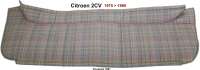
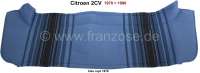
- Fabric (tartan): Typical of the 2CV6 Club and Dolly, in blue-gray with colored stripes.
- Faux leather: Often used in the 2CV Spécial and AK models. It is easy to maintain, but gets hot in the summer and cold in the winter.
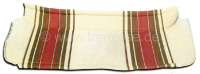
- Special models: The Charleston features gray diamond-patterned fabrics, while the Dolly often uses striped fabrics.
- In addition, there were many other seat covers in various colors and patterns. Most of the variants ever produced are still available today, generally for symmetrical and asymmetrical seat frames as well as for vehicles with front bench seats.
Adjustable backrest on the Citroën 2CV
An adjustable backrest was not a standard feature across all Citroën 2CV models, but rather a country-specific adaptation to national registration regulations.
Countries with adjustable backrests
The adjustable backrest is found primarily in Germany.
- Registration requirement: In Germany, an adjustable backrest—at least for the driver’s seat—was at times a prerequisite for type approval. Consequently, nearly all 2CV6 models exported to Germany were equipped as standard with individual seats, where the driver’s backrest could be adjusted via a hand wheel.
- Austria: This feature was also common in Austria. However, the regulations there were often interpreted less strictly than in Germany, which can still lead to questions regarding type approval for imported vehicles today.
Features and Limitations
- Driver’s seat only: Only the driver’s seat is adjustable. The passenger seat remained fixed to save costs.
- Mechanism: Adjustment is performed via a distinctive handwheel on the side of the seat frame.
- Issue with seat covers: In the version with an adjustable seat frame, the cover must be slightly opened at the seam where the handwheel is located so that the adjustment shaft can be inserted.
- Differences from other countries: In France, fixed bench seats or fixed individual seats remained standard, as there was no comparable legal requirement for backrest adjustment there.
Front Seats in the Citroën 2CV: Models and Countries
In the history of the 2CV, there was a significant shift from the continuous bench seat to individual seats.
- Standard until 1970/71: Until the early 1970s, the front bench seat was standard in almost all models, such as the AZ and AZAM.
- Specific models: The 2CV Spécial, as the entry-level model, retained the front bench seat as a basic feature in many markets even into the 1980s. The 2CV Spécial was never officially offered in Germany.
- Country-specific: In France, the bench seat remained standard in the base versions longer than in export markets such as Germany, where the 2CV6 was delivered with individual seats. The bench seat was also often standard equipment in the Kastenente (AK/Acadiane).
Replacing Citroën 2CV6 seat covers: Effort, tips, and differences from the Dyane
Is it difficult to change the seat covers?
To be honest: It’s not rocket science, but it’s a test of patience and can be quite a fiddly job. You don’t need any special upholstery skills, but you do need some perseverance.
Here is a realistic assessment of the difficulty levels.
The “Finger Workout”
The hardest part isn’t pulling the fabric over the seats, but hooking the rubber rings into place.
- Effort required: For each seat, you’ll need to hook about 80 to 90 elastic rings under high tension. Without the right lever tool, your hands will quickly tire.
- Time required: Allow about 1 to 1.5 hours per individual seat if you work carefully. The back seat usually takes a little longer.
The pitfall with the base
Often, you only realize when removing the old covers that the jute base or the foam has already crumbled.
- If you only replace the fabric cover but leave the rubber straps or jute mat in place, the result will quickly become saggy and uncomfortable.
- Tip: Replace the entire seat unit—including the jute mat, elastic bands, and foam—at the same time. While this is more expensive, it ensures significantly better seating comfort in the long run.
Fit of the Citroën 2CV6 seat covers
- Replica covers: There are inexpensive covers that run a bit too small. This requires pulling them tight, which puts strain on the seams.
- Symmetry: Pay close attention to whether the backrest has two curves at the top and is therefore symmetrical, or if one corner is angular. An incorrect cover will not fit properly over the frame.
Summary: Is it difficult?
- Technically: No. Basically, it’s just “hook it in and pull it over.”
- Physically: Yes. It’s hard on the hands and requires stamina.
Our tip: Change the seat covers on a warm day or in a heated room. When the fabric and elastic are warm, they stretch more easily. A little silicone spray or plastic wrap on the tubes also helps the cover slide into place more easily.
You should order these parts right away
To avoid having to stop in the middle of the job because an important small part is missing, you should order these three items right away:
- A complete set of seat rubber straps: It’s better to order a few more straps than you need. One or two tend to tear during installation, and it’s frustrating if you end up missing exactly 3 pieces. Allow for about 88 to 95 rubber pads per individual seat and about 180 for the back seat if all pads are being replaced. Often, however, it’s sufficient to replace only the seat cushion pads. In that case, you’ll need about 44 pads for an individual seat and 88 to 90 for a bench seat.
- Jute mats with wire reinforcement: After many years, the old mats are often cracked and stretched. If new seat covers are stretched over old, damaged mats, the seat will quickly sag again. With new jute mats or belt padding, the original seating comfort is restored.
- Foam pads: The foam between the jute and the cover has often disintegrated into dust or smells musty. New foam pads restore the seat’s proper shape and ensure that the new fabric fits tightly without wrinkling.
More tips for replacing the Citroën 2CV6 seat covers
With the Charleston design featuring the classic gray diamond pattern, precision is especially important, as crooked lines are immediately noticeable.
- Centering the diamonds: The pattern must be exactly centered on the seat cushion and backrest. If the row of diamonds sits lower on the left than on the right, the entire seat will look crooked. When attaching the first elastic bands, always use the center seam or the central row of diamonds as a guide and work evenly outward from there.
- Transition from seat to backrest: Make sure the diamonds on the seat visually blend into the diamonds on the backrest. If the pattern is offset at the bend, the seat looks unbalanced. Since the fabric on the 2CV6 is only stretched, you can still make minor adjustments of a few millimeters by choosing the right holes in the frame when attaching the elastic.
A little “pro tip”: When installing a Charleston cover, apply a very thin layer of spray adhesive to the new foam padding. This prevents the diamond pattern from shifting on the upholstery over time as you get in and out of the car.
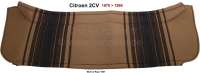
This tip is also helpful for striped seat covers, such as those commonly used in the 1970s and early 1980s.



 VIDEO
VIDEO 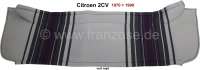
 Select your Citroen


 Please select your Peugeot


 Please select your Citroen Renault