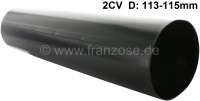
Suspension pot locking cap, for small suspension pot. Suitable for Citroen 2CV, Dyane. The lids are
inclusive brass bush and rear sealing ring. Per piece. Or. No. AZ434-96. Made by "Franzose / CiPeRe".


inclusive brass bush and rear sealing ring. Per piece. Or. No. AZ434-96. Made by "Franzose / CiPeRe".
year of construction 06/1972. Very good reproduction from the European Union.
year of construction 06/1972. Reproduction
of construction 06/1972. Very good reproduction from the European Union.
of construction 06/1972. Reproduction
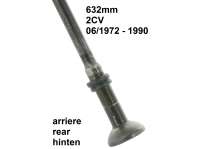
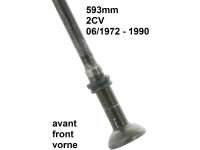
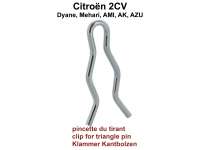
however on all 2CV to year of construction 1990). Suitable for all Citroen 2CV, Dyane, AMI. (Securement eye for the triangle pin at the radius arm). Per piece.
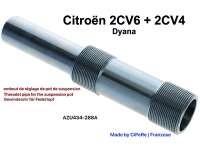
without nut`s. Suitable for 2CV (small suspension pot). Reproduction.
without nut`s. Suitable for 2CV (small suspension pot). Original one and/or own production, the better choice. Or.Nr.: AZU434288A
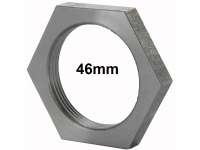
r small suspension pot. (46mm)
starting from year of construction 1955. Or. No. A435-1b. That is only the rubber, without metal plates!
2CV6. Reproduction, good quality. Made by Franzose/CiPeRe in Europe. We have now had the rubber stop made ourselves, as the quality has deteriorated in recent years. We have only cast the metal plate firmly with the rubber so that the weak point of water (rust) penetrating between the rubber and the metal plate can no longer occur.
Dyane, AMI, AK, AZU, ACDY.
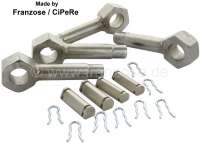
2CV. Consisting of: 2x triangle pin largely, 2x triangle pin small, 8x clip, 4x spring hinged tie bar adjustment from high-grade steel. 100% like original spare part. Same material. Rust protection such as original. Surface such as original, no sharp edges. Durability such as original! Better it does not go. Co-operation from Germany and the Netherlands. The triangle pins are produced from sinter metal (like original). The triangle pins must be put before the assembly, for a half hour into warm oil!
pot hinged tie bar at the radius arm). Measurement: 45 x 14,29mm. 100% like original spare part. Same material. Rust protection such as original. Surface such as original, no sharp edges. Durability such as original! Better it does not go. Co-operation from Germany and the Netherlands. Or. No. AM434-84A. The triangle pins are produced from sinter metal (like original). The triangle pins must be put before the assembly, for a half hour into warm oil!
hinged tie bar at the radius arm). Measurement: 45 x 14mm. Reproduction from South America.
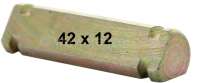
hinged tie bar at the radius arm). Measurement: 42 x 12,21mm. 100% like original spare part. Same material. Rust protection such as original. Surface such as original, no sharp edges. Durability such as original! Better it does not go. Co-operation from Germany and the Netherlands. Or. No. A434-84. The triangle pins are produced from sinter metal (like original). The triangle pins must be put before the assembly, for a half hour into warm oil!
hinged tie bar at the radius arm). Measurement: 42 x 12mm. Reproduction from South America.
pin largely, 2x triangle pin small, 8x clip. 100% like original spare part. Same material. Rust protection such as original. Surface such as original, no sharp edges. Durability such as original! Better it does not go. Co-operation from Germany and the Netherlands. Or. No. A434-84 + AM434-84A. The triangle pins are produced from sinter metal (like original). The triangle pins must be put before the assembly, for a half hour into warm oil!
for all Citroen 2CV, AK, Dyane, AZU. (small + large suspension pot) property reproduction, optically like original! Or.Nr.: A434.286.
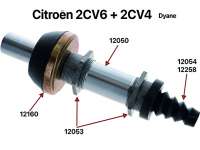
for all Citroen 2CV, AK, Dyane, AZU. (smaller + large suspension pot). This collar is from a improved rubber silicone mixture and has on the inside small splines, so that it cannot slip from the Threadet pipe. Or. No.: A434.286.
Synthetic. The friction lining is riveted on the metal plate. Suitable for Citroen 2CV.
AMI, AK, AZU, Mehari... Ricipot lubricant is supplied with a suitable cavity probe, making it very easy to apply to the suspension pot. It is based on technical castor oil and manufactured according to Citroen specifications at the time of production. Ricipot prevents creaking and squeaking of the suspension pots and prevents the risk of internal rusting of the suspension pots.
The suspension of the Citroën 2CV is known for its unique design and the comfort it provides.
The suspension system consists of so-called spring housings, which are mounted like horizontal suspension springs in metal tubes on the left and right sides beneath the floor panel. They are connected to the front and rear wheels via tie rods.
In 1938, Citroën’s president, Pierre-Jules Boulanger, tasked his engineers with developing a car capable of transporting two farmers in clogs, 50 kilograms of potatoes, or a barrel at a top speed of 60 kilometers per hour and with a fuel consumption of three liters per 100 kilometers. It also had to be able to drive on very rough roads and be light enough to be driven by a novice driver. The baskets of eggs on the back seat had to arrive intact.
This demanding specification led to a revolutionary yet cost-effective solution for the suspension. Engineer Alphonse Forceau was responsible for this. The 2CV’s handling, which remains unique to this day, is primarily due to its soft damping with long suspension travel.
For example, when a front wheel compresses, the corresponding spring in the spring housing is compressed. This allows the rear spring to extend. This interaction creates the unique driving experience of the Citroën 2CV.
Increased wear is to be expected in the area of the kingpins. Regular lubrication helps prevent damage.
The 2CV6 also has a horizontal telescopic shock absorber on each swing arm, which is attached to the swing arm and the vehicle chassis.
On older 2CV models with 375 cm³, 425 cm³, and 435 cm³ engines, so-called vibration dampers—large, oil-filled metal cartridges—are mounted on each wheel instead of shock absorbers. Additionally, the front swing arms are attached to the front axle with friction dampers.
In the 1970s, there were combinations of front friction dampers and front vibration dampers, as well as rear telescopic shock absorbers. However, starting with the 2CV6 at the latest, Citroën installed four telescopic shock absorbers. This configuration was retained until production ceased in 1990.
A resounding no. The 2CV never had stabilizer bars on the front or rear axles.
With the introduction of the Citroën AMI6, however, the front axle was partially equipped with a stabilizer bar to reduce excessive body roll. The Ami 8 was also equipped with a stabilizer bar.
A stabilizer bar mechanically connects the left and right control arms. It is a rod that can twist and is attached to the control arms on the left and right. It helps limit body roll in corners, thereby ensuring a more stable ride.
A squeaking shock absorber boot can often be repaired by lubricating it with castor oil. To do this, remove the boot from the tie rod and inject about 0.2 liters of oil using a syringe. If the squeaking or another noise reoccurs shortly thereafter, the shock absorber boot should be replaced. You can purchase special castor oil with a long spray nozzle from us under item number 12418.
The spring pots on the 2CV tend to rust through after 20 to 30 years. In most cases, only the sheet metal casing is damaged, while the inner components can still be reused. We carry new spring pot casings and spring pot sleeves in our product range.
To repair it, carefully open the old spring pot, remove the inner components, clean them, and regrease them. A removed spring pot is not under tension and can therefore be disassembled without any problems. Then, insert the individual parts into the new spring pot casing and weld on a lid.
Alternatively, we also offer completely new shock absorber housings with stainless steel casings, for example, item 12048. In addition, we provide all other components related to the shock absorber housing, including new tie rods, rubber buffers for mounting, installation hardware, maintenance oil, and boots.
The Fourgonnette, i.e., models such as AU, AZU, AK, and AKS, had to be designed for significantly higher payloads. The differences from the standard 2CV suspension lie in the details:



 Select your Citroen


 Please select your Peugeot


 Please select your Citroen Renault