engine cooling for Citroën 2CV 2CValt
14 Articles


Fan blade for 2CV4, Dyane 4, AZU of 250. 8 vanes, color black. Original supplier. Securement with 4
screws. Outside diameter 230mm. Diameter inside: 177mm. Pitch diameter: 162mm.
Tie-clip for the engine cowling sheet metal, for Citroen 2CV (8 per side are required. (to it
suitable screw = 20170)
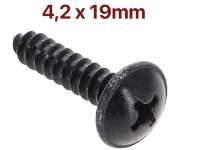
Belt pulley (without fan blade + V-belt), better than original (Made by Franzose). Suitable for
Citroen 2CV6, Dyane, Mehari. The belt pulley has been rotated from a 18kg steel block DIN 1,0501 (AISI/SAE 1040, EN C35). Fine balanced pulley, thus avoiding much pressure on the crankshaft. No risk of tearing off as it is not welded. Belt pulley is yellow galvanised (like original). Made by Franzose/Cipere, entire production process in Europe.
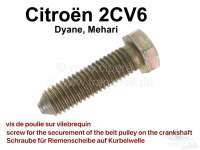

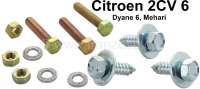
Screw, for the securement of the belt pulley, on the crankshaft. Suitable for Citroen 2CV 16 HP
not fitting for 2CV6! Or.Nr. A24195
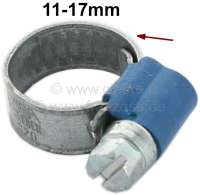
Hose clamp 11-17mm, especially for radiator hose. Vintage look. Embossed band with raised edges
This prevents the hose from being damaged. Small screw housing with 7mm hexagon head screw (with slot). Normal, modern hose clamps squeeze the hose. This is completely avoided with these clamps. And they even look better.
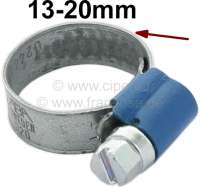
Hose clamp 13-20mm, especially for radiator hose. Vintage look. Embossed band with raised edges
This prevents the hose from being damaged. Small screw housing with 7mm hexagon head screw (with slot). Normal, modern hose clamps squeeze the hose. This is completely avoided with these clamps. And they even look better.
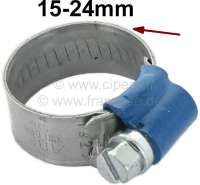
Hose clamp 15-24mm, especially for radiator hose. Vintage look. Embossed band with raised edges
This prevents the hose from being damaged. Small screw housing with 7mm hexagon head screw (with slot). Normal, modern hose clamps squeeze the hose. This is completely avoided with these clamps. And they even look better.
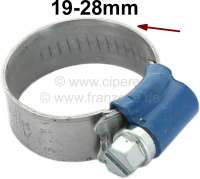
Hose clamp 19-28mm, especially for radiator hose. Vintage look. Embossed band with raised edges
This prevents the hose from being damaged. Small screw housing with 7mm hexagon head screw (with slot). Normal, modern hose clamps squeeze the hose. This is completely avoided with these clamps. And they even look better.
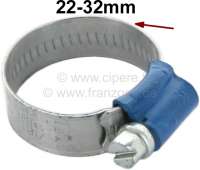
Hose clamp 22-32mm, especially for radiator hose. Vintage look. Embossed band with raised edges
This prevents the hose from being damaged. Small screw housing with 7mm hexagon head screw (with slot). Normal, modern hose clamps squeeze the hose. This is completely avoided with these clamps. And they even look better.


14 Articles
Citroën 2CV Cooling, Airflow, and Fan Blade for 375, 425, and 435 cm³
None of the Citroën 2CV models with 375, 425, and 435 cm³ have a water cooler. These vehicles are equipped with air-cooled two-cylinder boxer engines. Cooling is achieved by the airflow generated by the fan, which is directed specifically over the cylinders and cylinder heads.
Therefore, the coolant level is not checked on these engines. It is crucial that the cooling airflow passes completely and properly through the engine. All cooling air deflectors, air ducts, fan housings, and seals must be installed correctly.
Individual details may vary depending on the model year, engine type, and configuration. However, the basic principle remains the same: Cooling will only function reliably if the fan is working properly and the airflow is unobstructed.
Which 2CV models are covered?
This text refers to the early and mid-production 2CV models preceding or produced alongside the later 2CV6, specifically vehicles with:
- 375 cm³ engine
- 425 cm³ engine
- 435 cm³ engine
Depending on the model year and market, these include, among others, early 2CV A, 2CV AZ, AZL, AZLP, AZAM, and 2CV4 models with a 435 cm³ engine. Individual technical details may vary depending on the engine, model year, and country-specific version.
Why airflow is so important in these 2CV engines
The fan blade is mounted at the front of the engine and forces cooling air through the fan housing over the hot engine components. The air must be directed specifically over the cylinders and cylinder heads so that heat can be reliably dissipated.
The cooling air baffles on the engine are no minor detail. They are a vital component of the cooling system. If a baffle is missing, an air duct is misaligned, or a housing component is leaking, cooling air can escape before it reaches the critical areas.
The engine may then run normally while stationary but still overheat during extended rides, under heavy loads, in summer heat, or on inclines.
Special Features of the 375, 425, and 435 cm³ Engines
In the smaller 2CV engines, the cooling capacity is tailored to the respective engine power and design. These engines are robust, but they do not have the same cooling reserve as a water-cooled engine.
Especially under today’s driving conditions, these vehicles are often driven differently than in the past. Longer trips, sustained high RPMs, hot summer days, vacation trips, or mountain routes place greater strain on the engine. This makes proper airflow, a clean engine compartment, and a correctly mounted fan blade all the more important.
Citroën 2CV Fan Assembly and Fan Blades
The fan impeller is a critical component in all air-cooled 2CV engines. It must not be damaged, loose, or incorrectly installed. After working on the alternator, V-belt, ignition system, front engine housing, or fan housing, you should always check the following:
- Is the fan wheel properly seated on the crankshaft?
- Is the central mounting properly tightened?
- Is the fan wheel rubbing against the housing?
- Are any blades broken, bent, or damaged?
- Is the fan housing fully assembled?
- Are all cooling air baffles and air guides correctly installed?
A damaged or loose fan impeller can significantly reduce cooling performance and, in the worst case, cause consequential damage to the motor.
Cooling Air Intake and Front Area
Even the best fan is of little help if not enough air is entering the engine compartment from the front. The cooling air intake must therefore remain unobstructed.
Additional headlights, improperly mounted license plate holders, decorative decals, accessories, luggage, or winter covers can obstruct the airflow.
A winter cover is only useful in cold weather. In milder temperatures, it should be removed so that the engine receives sufficient cooling air.
Oil Level and Oil Quality
The oil level is also very important for the 375-, 425-, and 435-cm³ engines. Too little oil not only results in poorer lubrication but also in poorer heat dissipation.
The oil level should always be checked before long trips, highway driving, vacation trips, or mountain routes. Old or heavily contaminated oil is also undesirable. Oil changes should therefore not be unnecessarily delayed.
A clean oil system, the right oil quality, and unobstructed airflow are more important for the longevity of these engines than retrofitted aftermarket solutions.
Typical Weak Points in the Cooling System
Missing or Incorrectly Installed Cooling Air Deflectors
After engine work, clutch work, or restorations, small air deflectors are often missing or not installed correctly. This can significantly reduce cooling efficiency.
Leaky air ducts on the fan housing
Cracks, poorly fitting housing parts, missing gaskets, or bent metal sheets allow cooling air to escape. As a result, less air reaches the cylinders and cylinder heads.
Contaminated engine parts
Oil mist, dust, leaves, insects, and old dirt can accumulate on cylinders, cylinder heads, and air ducts. These layers of dirt act as insulators and impair heat dissipation.
Mouse nests, leaves, and foreign objects
After prolonged periods of inactivity, cylinders, fan housings, and air ducts should always be checked for leaves, nests, and foreign objects. Such deposits act as thermal insulation and can lead to severe overheating.
Improperly Installed or Damaged Heating and Air Hoses
Warm air is directed to the outside or into the passenger compartment via heat exchangers and air ducts. If hoses are missing or improperly installed, this can impair airflow and heating performance.
Not all overheating is caused by the cooling system
If a 2CV with a 375, 425, or 435 cm³ engine overheats despite proper airflow, the ignition, carburetor, air leaks, and valve clearance should also be checked.
Incorrect ignition timing, a mixture that is too lean, secondary air, or improperly adjusted valves can increase the combustion temperature.
Sustained high RPM in hot weather, headwinds, uphill climbs, or when fully loaded also generates a lot of heat. The engines are robust, but their cooling system only works reliably if airflow, oil condition, and engine tuning are correct.
How can you tell if there are cooling problems?
Possible signs of cooling problems include:
- decreased power when the engine is warm
- Ringing or knocking under load
- an unusually hot oil smell
- very thin oil after driving
- Hot-start problems
- Increasing oil leaks
- Noticeable discoloration on engine parts
- Reduced heating performance despite a warm engine
- Unusual noises coming from the fan area
- A V-belt that slips or wears out rapidly
An oil temperature gauge is not strictly necessary for standard vehicles, but it can be helpful for frequent summer drives, mountain routes, or longer trips.
Practical Checklist for the Cooling System
- Check the oil level before long trips.
- The front cooling air intake must remain unobstructed.
- Any winter cover that may be installed should be removed when temperatures are milder.
- During maintenance, check the fan blade, fan housing, cooling air deflectors, air hoses, and air ducts.
- After a long period of inactivity, check for leaves, mouse nests, and foreign objects around the cylinders and fan housing.
- If overheating occurs, also check the ignition, carburetor, air leaks, valve clearance, and oil condition.
The most important rule is: For 2CV models with 375, 425, and 435 cm³ engines, cooling is only as effective as the airflow. Complete and airtight cooling fins are crucial for maintaining the engine temperature.
Citroën 2CV Fan Blade and Fan/V-Belt Pulley for 375, 425, and 435 cm³
On Citroën 2CV models with 375, 425, and 435 cm³ engines, the fan blade is located at the front of the engine. Depending on the model year and engine variant, the exact design of the fan blade, pulley, and mounting may vary.
However, the basic principle remains the same: The fan must be securely fastened, run smoothly, and reliably circulate cooling air through the fan housing.
In many designs, the fan/pulley assembly sits on a tapered section of the crankshaft. It is important to note that it is not the fan blade that holds the pulley on the crankshaft, but the tapered seat. The central screw pulls the assembly onto the taper and secures it there.
For older or different engine variants, the specific design on the vehicle should be checked.
Inspect the fan blade
Carefully inspect the fan for damage. The following are particularly important:
- Cracks in the hub
- broken mounting areas
- Damaged or dented blades
- visible hairline cracks
- Deformations or scuff marks
A damaged fan should be replaced. A fan that breaks can damage the fan housing, the cooling air duct, and other components. For longer trips, it may be a good idea to carry a suitable replacement part.
Check the pulley for concentricity
Also check the pulley. If it has been pried with tire levers or screwdrivers in the past, it may be warped.
A pulley that is out of round often leads to V-belt wear, noise, vibrations, and reduced alternator performance. It also increases the risk of material fatigue and breakage.
Practical Recommendation
If the fan has not been removed for an extended period, do not use force. Careful, precise work is more important here than brute force.
The cone can be very tight. Damage caused by improper prying or hard blows is usually much more time-consuming to repair than using the correct tool.
After reassembly, the engine should be run briefly. Observe from the front to ensure the fan is running smoothly. The V-belt must not slip, and there must be no grinding against the fan housing.
Afterward, the V-belt tension should be checked again.
 Select your Citroen


 Please select your Peugeot


 Please select your Citroen Renault