shock absorber - suspension balls for Citroën 2CV AK-AZU
6 Articles


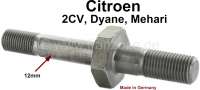


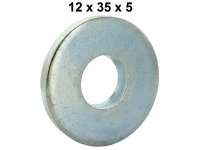
Friction shock absorber (complete with cap, rubber cap), at the front axle. Suitable for Citroen
2CV starting from year of construction 1955. Reproduction.
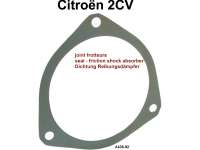
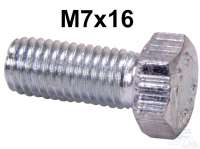
Shock absorber short, suitable for Citroen AK in front + rear, AMI 6 + 8 for in front and rear
ACDY only in front! (per piece). 14mm securement eye. Note: There are also Ami 6 vehicles, which are equipped shock absorbers with 12mm shock absorber in front, and rear 14mm. Then please, select for in front shock absorbers the number 12319 . Manufacturer "Record France". Length when pushed together: 335 mm. Length when pulled apart: 495 mm.
6 Articles
Citroën AZU Friction Dampers: Differences from the 2CV Sedan
The Citroën AZU, the delivery van based on the 2CV, has several key differences in its friction dampers compared to the sedan. These are primarily related to the higher payload and the greater stress experienced during transport operations.
Damping Force Adjustment
Since the AZU is designed for cargo transport, the friction dampers are set stiffer than on the sedan.
- While the sedan is often set to approximately 40–45 kg on the 1-meter lever at the front, the value on the AZU’s rear axle is significantly higher to prevent the loaded cargo body from rocking.
- A target of 50–55 kg is often used as a guideline for the AZU at the rear, especially if the vehicle is regularly loaded.
Differences in production periods for the Citroën AZU
The AZU developed differently from the 2CV sedan in several respects.
- Early AZU models, like the sedan, had friction dampers all around as well as inertia dampers (batteurs).
- Due to the higher stress on the vans, experiments with reinforced springs or other damper combinations began earlier. However, the basic system with friction dampers at the front remained largely identical until the mid-1970s.
- In the AK models, such as the AK350 and AK400, the friction dampers were often replaced earlier with hydraulic shock absorbers due to the higher payload of 350–400 kg, as the mechanical friction dampers were reaching their limits.
Reinforced Components for AZU and AK
Some spare parts lists include special reinforced star springs for AZU and AK models. These have a higher spring rate and increase the contact pressure on the friction disc without requiring the adjustment nut to be tightened all the way.
What to watch out for when repairing the AZU
- Housing fatigue: Due to the higher load and stiffer setting, the sheet metal housings of the friction dampers on the AZU are more prone to hairline cracks or warping. The areas around the mounting holes, in particular, should be carefully inspected.
- Heat generation: Stifferly adjusted friction dampers generate more heat on rough roads. This can cause friction discs to glaze over more quickly and lose effectiveness.
- Adjustment: The basic principle is identical to that of the sedan, but the AZU requires significantly more damping effect. During restoration, the friction dampers should therefore be adjusted toward the upper end of the tolerance range.
 Select your Citroen


 Please select your Peugeot


 Please select your Citroen Renault