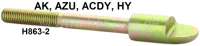
Axle (7,5 x 60mm) for the door hinge and for the hinge of the luggage compartment lid. Suitable for
Citroen 11CV. Or. No. 224118A


Citroen 11CV. Or. No. 224118A
reproduction, like original!
reproduction, like original!
simply MP3 player, Smartphones etc. Suitable for all classical Blaupunkt radios supplied by us.
(Zenith to Solex). Suitable for Citroen 11CV with D engine.
delivery with EC-R55.01 checking! Trailer hitch tongue load: 75kg. Trailer weight: 1250kg. Total width: 970mm.
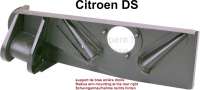
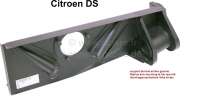
cross beam rusted very often extremely. Length: 790mm. Wide one: 100mm. Height: 95mm. This Travere are installed by the most French tow trailer couplings. It does not fit for "BRINK" or "Westfalia" tow trailer couplings.
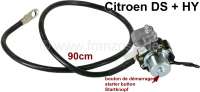
motor can also be used with Citroen DS, which does not has a magnetic switch on the starter motor. Therefore either only the magnetic switch is bridged, or it is controlled with the relay at the battery. This additionally protects the expensive battery relay.
09/1968. Plus 250 Euro Old part deposit!
Volt, 1.4KW! This smart high-performance starter motor has an intermediate gearbox. As a result, it has approx. twice the performance of a standard starter motor with half the power consumption and only 3.8kg weight! Based on a DENSO motorsport starter.
to 09/1968! 12 Volt, 1,4KW! 10 teeth. This smart high-performance starter motor has an intermediate gearbox. As a result, it has approx. twice the performance of a standard starter motor with half the power consumption and only 3.8kg weight! Based on a DENSO motorsport starter. Replaces original starter: Paris Rhone D10E49, Ducellier 6166C
1975! 12 Volt, 1,4KW! 9 teeth. Without holder for heat shield. This smart high-performance starter motor has an intermediate gearbox. As a result, it has approx. twice the performance of a standard starter motor with half the power consumption and only 3.8kg weight! Based on a DENSO motorsport starter.
1965! 12 volt, 1.4KW! 9 teeth. This smart high-performance starter motor has an intermediate gearbox. As a result, it has approx. twice the performance of a standard starter motor with half the power consumption and only 3.8kg weight! Based on a DENSO motorsport starter.
necessary! For mounting: Mount the small cable bridge (between the screw connection 8mm and the tongue connection above). This cable bridge is included with the starter. Function with the HY: The starter relay at the positive pole cable at the battery switches directly the terminal 30 (plus) at the starter. Now the current flows via the cable bridge to terminal 50 (tongue connection, control connection). This causes the solenoid switch to pull in and push the pinion forward. This closes the contact on the starter itself.
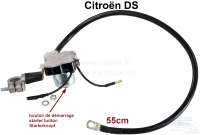
New part! No old part return necessarily! If you have a Citroen DS with starting relays at the battery (Pallas), you can trigger the magnetic starting switch simply with the relay!
Teeth: 9 teeth. 3 mounting holes. Mounting position: On the left of 48°. Direction of rotation in in the clockwise direction. The starter motor is a new part. An old part return is not necessary!
starter brushes are mounted also in many other French vehicles. For starter motor Paris Rhone, series D10. Width: 18,0mm. Height: 14,0mm. Depth: 7mm. Or. No. Citroen: DX533111A + Peugeot: 182064
18 x 7mm. Or. No. 701863
1966 (6 V, A533-15). Citroen HY, 12 V (Or. No. 2D5423368C). Peugeot 203, 403, 404, 204. Panhard. Renault Dauphine, R8, Floride, Caravelle, R4, Estafette. Simca. Dimension: 15.0 x 8.0 x 15,0mm.
Citroen DS, with on the right mounted battery (front seat passenger side). Or. No. 2D5401569G
Citroen DS (with left mounted battery) + Citroen HY. Or. No. 2D5401570T
supply reservoir, to the hydraulic pump. Suitable for Citroen DS. Or. No. DXN394-72. 1000mm long. Made in Germany
x 20 UNF. Internal thread: 11/16 x 16 UNF. Suitable for Citroen 11CV + 15CV, HY. Dimension: 22 x 32mm. Or. No. 438359
beautiful flagpole antenna from Europe. The flagpole antenna is from high-grade steel. Required drill hole: 12.0mm. Length (depth) of the antenna tube in the wing: 260mm. Antenna extended: 900mm.
vehicles. E.G. with Citroen 2CV, Renault R4, Citroen HY etc.
or by brake; anti-slide-coats on both sides. For car, boat, caravan
bearing cups have a diameter of 34mm. Height of 14mm.
of construction 1965. Or. No. D3762
Citroen HY. Diameter: 85,5 + 32mm. Or. No. DS373-88
year of construction 9/1965 to 3/1970. Citroen HY. Diameter inside: 80 + 30,0mm. Or. No. DX373-88



 Select your Citroen


 Please select your Peugeot


 Please select your Citroen Renault