Design Differences Between Citroën A-Series Engines with 375, 425, and 435 cm³
There are significant technical differences between the Citroën A-model engines with 375 cm³, 425 cm³, and 435 cm³. These engines should therefore not be evaluated solely based on displacement. Accurate identification of the specific engine version is particularly important for pistons and cylinders, the camshaft, and the crankshaft.
Quick answer on compatibility
The 375 cc, 425 cc, and 435 cc engines are not readily compatible with one another.
Depending on the model year and version, they differ in several aspects, including:
- Displacement and power
- Compression
- Intake and carburetor
- Cooling
- Engine block
- Crank mechanism
- Camshaft
- Attachments
- Clutch and flywheel side
The 375-cc engine is one of the early 2CV A-series versions. This was followed by various 425-cc versions for the AZ, AZU, and related models. The 435-cc engine was later used in the 2CV4 and Dyane 4, among others, and technically belongs to a more modern generation of A-series models.
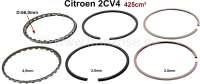
Citroën A-Model Pistons and Cylinders
The most significant differences are found in the pistons and cylinders. Even though the engines may appear similar on the outside, the components are not automatically interchangeable.
| Engine |
Typical Use |
Important Notes |
| 375 cm³ |
Early 2CV A / AU |
Early in-house design; not to be confused with later engines |
| 425 cm³ |
2CV AZ / AZU, various power ratings |
several versions; not every 425-cc engine is the same |
| 435 cm³ |
2CV4, Dyane 4, and similar A-series models |
Later version, cannot simply be combined with 425 cc |
Important: 425 cm³ does not automatically mean 425 cm³. Over the course of production, there were various versions with different power ratings, compression ratios, and technical specifications. Therefore, pistons and cylinders should always be selected to match the exact engine code and the existing engine block.
Citroën A-Model Camshaft
You should also assume technical differences when it comes to the camshaft. The various performance levels of the A-model engines were not achieved solely through displacement. Compression ratio, valve timing, intake system, carburetor, exhaust system, and ignition are also decisive factors.
A camshaft from another 425-cc or 435-cc engine may appear similar at first glance, but it may not match the desired engine characteristics or the existing engine configuration.
Therefore, the following applies
The camshaft should always be selected to match the exact engine version.
Before installation, the engine code, housing design, carburetor, intake manifold, and ignition should be checked.
Citroën A-Model Crankshaft
Special care is required with the crankshaft. Displacement is determined not only by the bore but also by the stroke. If the engine family, displacement, or production period changes, the crankshaft may also differ.
The 375-cc engine is an early design. The 425-cc engine was further developed in several variants. The 435-cc engine belongs to the later 2CV4 and Dyane 4 generation. In addition, the clutch, flywheel, alternator or dynamo, fan, intake system, and engine housing also changed over the course of production.
Therefore, crankshafts should not be interchanged between 375, 425, and 435 cc engines without first checking the following points:
- Engine identification
- Casing design
- Bearing arrangement
- Flywheel side
- Clutch design
- Oil supply
- Year of manufacture and vehicle model
425 cm³ and 435 cm³: Common Confusion
The 435-cc engine is often confused with the 425-cc engine because their displacements are very similar. Technically, however, this equivalence is not accurate.
The 435-cc engine was used, among other models, in the 2CV4. It belongs to a later technical generation and differs from the 425-cc engine in several details. Depending on the version, these may include the intake system, alternator, fan, transmission area, and other components.
The 435 cm³ engine is therefore not simply a later version of the 425 cm³ engine.
For pistons, cylinders, camshaft, and crankshaft, this version should always be considered separately.
Rule of thumb for selecting parts for Citroën A-series engines
To ensure you select the correct parts, you should always check in this order:
- Engine code or engine label
- Year of manufacture
- Vehicle model
- Displacement: 375, 425, or 435 cm³
- Early or late model
- Intake, manifold, and carburetor
- Clutch and flywheel side
- Crankshaft, camshaft, pistons, and cylinders as a single assembly
Summary of Citroën A-series engines
There are significant design differences between the Citroën A-model engines with 375 cm³, 425 cm³, and 435 cm³ displacements. Pistons and cylinders, camshafts, and crankshafts should therefore not be selected based solely on displacement.
Early 375-cc engines, the various 425-cc versions, and the later 435-cc engines of the 2CV4 differ in design, power output, compression ratio, intake system, and engine configuration.
For a reliable repair or engine overhaul, you should therefore always check the exact engine version. What matters is not just 375, 425, or 435 cm³, but above all the engine code, year of manufacture, existing engine block, and the specific version installed.




 Select your Citroen


 Please select your Peugeot


 Please select your Citroen Renault