Citroën 2CV Ignition System and Replacement Parts
The ignition system of all Citroën 2CV engines ever built (as well as those of the Dyane, Mehari, AMi6, and AMi8) is based on the same simple principle. These engines do not have a traditional ignition distributor. A movable cam is mounted at the front end of the camshaft, which opens and closes the ignition contact. This cam is spring-mounted on two weights. As the engine speed increases, centrifugal force causes these weights to change the position of the cam. This ensures a variable ignition timing curve (advanced ignition).
The unique feature is that the ignition contact opens with every engine revolution (in a four-stroke engine, opening the ignition contact is actually only necessary every other revolution). Therefore, the cylinder fires even when no spark is required. This principle is also used in classic Harley-Davidson motorcycles. The spark thus jumps once during the intake stroke.
Spare Parts for the Ignition System
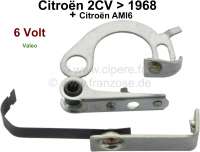
We carry all spare parts for the ignition system, regardless of the model year. However, the quality of the ignition contacts and capacitors has deteriorated significantly. Regular inspection and replacement of the ignition contacts and capacitor are absolutely necessary to ensure the engine runs smoothly. These components are somewhat awkwardly located behind the fan blade, which makes maintenance work relatively time-consuming and expensive. Access is still relatively good on the 2CV, but it is much more complicated on the Dyane, Mehari, and AMI, as the front grilles sometimes have to be removed first.
Advantages of the electronic ignition system
However, there is a great solution: the electronic ignition system. We recommend using an electronic ignition system, as it makes starting the engine considerably easier. It also delivers consistent ignition performance and significantly reduced maintenance requirements compared to conventional ignition systems. The latter are often associated with wear and misalignment of the ignition contact. An electronic ignition system, on the other hand, operates contactlessly, ensuring consistent performance throughout its entire service life.
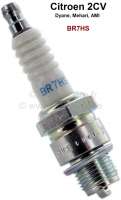
It also allows for more precise control of the ignition timing. Along with a high-performance ignition coil—which we also recommend—we include new spark plugs and ignition wires. We have already sold over 10,000 ignition systems that work flawlessly. Installation is relatively quick even for beginners, and detailed installation instructions are included. We drive our own 2CV exclusively with the electronic ignition system—and it has never let us down.
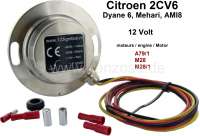
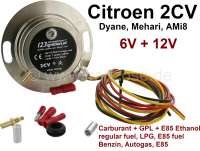
The ignition system is microprocessor-controlled and works even with low battery power. The centrifugal weights for the advance ignition and the cam that actuates the ignition contacts are removed. Instead of the centrifugal weights, two small caps with magnets are placed on the mounts, which act as sensors for the Hall effect sensors. This eliminates wear and tear. The ignition timing is also very easy to adjust. The ignition system has a built-in LED for this purpose. All you need is a 6-mm drill bit to find and set the ignition timing on your engine.
So say goodbye to time-consuming maintenance and poor engine starting, especially in wet conditions. Fuel consumption is also slightly reduced by the electronic ignition system. Set it up once and forget about it. Of course, the spark plugs and ignition cables should still be replaced regularly (high-quality versions are available). You’ll also notice the engine revs up more smoothly. The engine also responds better when you change throttle positions. The ignition system replaces the original ignition contact box and is therefore not visible.
Available electronic ignition systems
We carry electronic ignition systems for all 2CV engines ever installed. For the 2CV6 (or other Citroëns with the 602 cc M28 engine), we carry the ignition system under part number 14300. As a more affordable alternative, we also offer a replica ignition system. Of course, you’ll also find 6- and 12-volt ignition systems for the 375 cc, 425 cc, and 435 cc engines.
What exactly is early ignition?
When the piston moves upward in the engine, it compresses the fuel-air mixture that has previously flowed in through the intake valve. Once the piston is at the top, the spark plug must ignite the mixture. This pushes the piston downward, causing it to move again.
In practice, however, it takes a moment for the fuel-air mixture to explode after the spark plug fires (time delay). This would mean that the piston gets hit hard when it is already on its way back down, since the explosion in the cylinder occurs too late. This leads to a significant loss of power.
The spark plug must therefore fire earlier, while the piston is still on its way up. When the piston is at the top, this is called top dead center (TDC). When the piston reaches TDC, the explosion should have its greatest effect. This is why there is an advance ignition adjustment.
In the Citroën 2CV6, the spark plug typically fires 8° before top dead center (TDC) at idle speed. If the engine is now running faster, the ignition timing must be adjusted accordingly, e.g., to 20°, so that the full force of the explosion acts on the piston as it moves downward again. If ignition occurs too early, the explosion may take place while the piston is already on its way up toward TDC.
The result is a loss of power and, eventually, engine damage. This phenomenon is also known as engine knocking. Therefore, it is very important to check the ignition system regularly. It is even better to replace the mechanical ignition timing adjustment with an electronic ignition system.
Summary of the Citroën 2CV’s Ignition System
The ignition system of the Citroën 2CV is legendary for its radical simplicity. Its most distinctive feature is that it operates without a distributor. Here are the three key characteristics:
- The “wasted spark” principle: On the 2CV, the ignition coil always fires into both cylinders simultaneously.
- The dual ignition coil: The 2CV’s ignition coil has two high-voltage outputs (one for each spark plug).
- The location of the breaker contacts: These are mounted directly on the camshaft behind the fan.
A modern replacement is the electronic ignition system, as the mechanical contacts require frequent maintenance and the ignition timing shifts due to wear. This system is completely housed within the engine fan housing behind the fan wheel, making the ignition maintenance-free.


 PDF FILE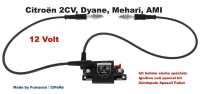















 Select your Citroen


 Please select your Peugeot


 Please select your Citroen Renault