Drive Shafts for the Citroën 2CV
The drive shafts transmit the torque from the transmission to the wheels. Since the wheels can compress, the length of the drive shafts also changes as they must follow the suspension movement. Therefore, the drive shafts are adjustable in length (this is also referred to as length compensation or sliding joints).
If the vehicle has front-wheel drive (which all Citroën 2CVs do), the driveshaft must also perform the steering movement. Special boots are used to protect the joints. For this reason, it is crucial that the boots are in perfect condition. If dirt accumulates in the joints, this can lead to rapid wear, as a driveshaft rotates several hundred times per minute.
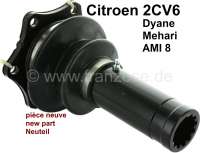
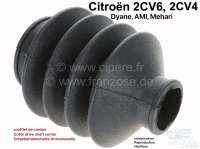
We offer new driveshafts for the 2CV6. We carry high-quality aftermarket replicas, as well as driveshafts from a major brand manufacturer. Of course, you also have the option to purchase driveshaft boots in various grades. Additionally, we carry improved boots made of silicone or neoprene in our product range. Naturally, we also stock all necessary fasteners, such as the rare M9 screws, in our inventory.
Development History of the Citroën 2CV Drive Shafts
The drive shafts of the Citroën 2CV have undergone an interesting development history, which was primarily characterized by improvements in ride comfort and durability. The development history of the drive shaft types can be summarized as follows:
For the A-models, there are essentially three generations:
- Simple universal joints (until around the mid-1960s): The early models (AZ, AU) had simple universal joints on the wheel ends. Problem: These joints are not “homokinetic” (constant-velocity). During sharp turns, the car began to jerk or “bounce” because the angular velocity of the wheel changed constantly during a rotation.
- Double universal joints (approx. mid-1960s to mid-1970s): To eliminate jerking during steering, Citroën installed two universal joints on each wheel side, positioned directly one behind the other. Effect: This design functions like a constant-velocity joint. The angular changes cancel each other out, which massively improved ride comfort in curves. They are recognizable by the two large rubber boots on each side.
- Modern constant-velocity joints (Rzeppa principle, from approx. model year 1974/75): Technology: The latest generation (standard on the 2CV6, Dyane 6, and Acadiane) uses modern ball-type constant-velocity joints, as are common in today’s cars. Advantage: They are more compact, require less maintenance, and allow for an even smoother ride at full steering lock.
Important notes on 2CV drive shafts
What you need to keep in mind with 2CV drive shafts:
- Check the gear teeth. There are different gear teeth on the wheel side. Older transmissions (e.g., from the 425-cc engine) often have narrower or different gear teeth than the newer disc brake transmissions of the 2CV6.
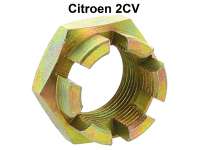
- Tightening torque: The large crown nut on the wheel hub must be tightened to a very high torque (approx. 350 Nm). If it is too loose, it will quickly damage the wheel hub’s teeth.
- When replacing them, use only high-quality boots (e.g., made of neoprene). Cheap rubber boots often crack after just a few thousand kilometers due to the 2CV’s extreme suspension travel.
- Lubrication: All currently installed drive shafts still have grease fittings. These were previously used for the universal joints and for length compensation. Drive shafts with constant-velocity joints now only have a grease fitting for length compensation (sliding gear teeth). These must be regularly lubricated with grease.
Removal: On the 2CV6 (models with disc brakes from around 1981 onward), replacing the driveshaft is somewhat easier than on the older 2CVs with front drum brakes, thanks to the modern constant-velocity joints. However, there are a few “2CV-specific” tricks:
- The right tools: You absolutely need a 32 mm socket and a solid ratchet or a very powerful impact wrench. The crown nut is extremely tight!
- Remove the split pin from the crown nut.
- Loosen the crown nut: It is important to loosen the large crown nut on the wheel hub while the car is still on its wheels. Often, a long pipe is needed as an extension, since a great deal of force must be applied (or, of course, much more conveniently, an impact wrench).
- Gearbox-side mounting: On the 2CV6, the shaft is flanged to the brake disc on the gearbox side with four screws (M9) and two stud bolts (M9). These screws have a 14 mm head (typical for Citroën). Of course, it’s much easier if you remove the fender first. It’s just 4 nuts!
Clean the threads thoroughly before installing the new bolts. Caution: Always use new M9 lock washers when reinstalling the new shaft.
The “trick” for removal
You don’t have to completely disassemble the 2CV6 to remove the shaft: Jack up the car and turn the steering wheel all the way in the opposite direction (if you want to replace the left shaft, turn the wheel all the way to the right). You can loosen the steering lever on the steering knuckle (2 M7 bolts secured with a lock washer) to create more clearance and pull the shaft out of the wheel hub. Be sure to use a new lock washer for reassembly! Our part number 12011.
Assembly and Torque
Apply grease to the splines at the front of the drive shaft. Ensure cleanliness and make sure no grease gets on the brake discs, as the shaft is flanged directly to the brake disc. The tightening torque for the crown nut on the wheel hub is approx. 350 Nm. This is “as tight as possible” using a standard ratchet. Be sure to use a new split pin afterward! The drive shaft also centers the front wheel bearing! So please, don’t hold back when tightening the crown nut!
Quick tip: Since the drive shaft on the 2CV6 is bolted to the brake disc, this is the perfect opportunity to check the brake discs for runout or wear. Since the bolts are being removed anyway, you have direct access to the brakes.








 Select your Citroen


 Please select your Peugeot


 Please select your Citroen Renault