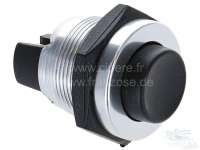
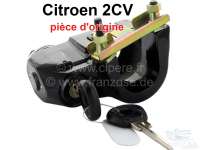
Ignition lock in the dashboard, for Citroen 2CV with starter button (with 2 connections). The
ignition lock also fits in the Citroen DS until 1967, AMI6 and Citroen HY. Reproduction, incl. 2 keys.


ignition lock also fits in the Citroen DS until 1967, AMI6 and Citroen HY. Reproduction, incl. 2 keys.
ignition lock also fits in the Citroen DS until 1967, AMI6 and Citroen HY. Reproduction, incl. 2 keys.
of manufacture 1974 (for export countries at that time like Germany). The lock already locks when the ignition key is turned to the neutral position (zero position), but is still in the lock. Incl. key + U-bolt for mounting on the steering column. Connection in driving direction seen: above malve (pink), left black, with some 2CV`s also blue, right red. Original Citroen, no replica. Made in France
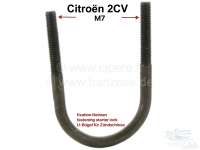
U-shaped bracket for the securement at the steering column. This ignition lock is the new version, installed from 1974 to 1990. The lock only locks when the ignition key is removed. Connection, in direction of travel seen: above malve (pink), on the left black or blue, on the right red.
size of door keys, for vehicles with starter button). Shaft length: 17,3mm. Shaft width: 7,0mm.
Citroen Mehari, of year of construction 1968 to 1987. For starter lock manufacturers: NEIMAN. Please observe the cross section of the key bit. Shaft length: 33,0mm. Shaft wide: 7,6mm.
starter lock manufacturers: NEIMAN. Please observe the cross section of the key bit. Shaft length: 33,0mm. Shaft wide: 7,6mm.
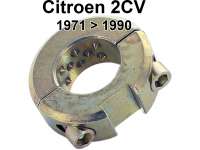
year of construction 1/1971. Or. No. 5 410 508
year of construction 1/1971. Like original, with the pointed claws inside. Or. No. 5410508
lock yokes, for Citroen 2CV. Made in Germany.
high-grade steel! For Citroen 2CV. Made in Germany.
for Citroen 2CV. Made in Germany.
construction 1974. That is the bow, with which the starter lock is screwed on to the steering column.
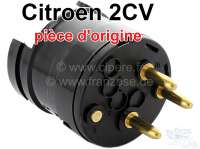
connections. Connection in direction of travel seen: malve above (pink), on the left black or blue, on the right red.
connections. Reproduction. Connection in direction of travel seen: malve above (pink), on the left black or blue, on the right red.
It wasn’t until 1952 that an ignition switch was introduced in the Citroën 2CV.
This was continuously refined and, in some cases, equipped with an anti-theft device that locked the steering column. With these early ignition locks, only the ignition could actually be turned on. The starter motor continued to be operated purely mechanically via a cable pull.
Starting with the 1965 model year, the electrical system was converted from 6 volts to 12 volts.
As part of this conversion, which lasted until 1970 depending on the model and country of delivery, an electric starter with a solenoid switch was also installed. The cable pull for the starter was thus eliminated.
Initially, the starter motor continued to be operated via a starter button.
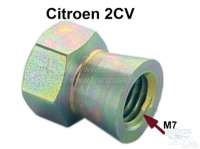
In 1974, the ignition switch was redesigned and remained unchanged until production ended in 1990. The new ignition lock featured a steering column lock as an anti-theft measure and simultaneously mounted the steering column within the body. The combined ignition lock with anti-theft protection was secured to the body using a 7-mm U-bolt with anti-theft shear nuts.
Initially, there were still 2CV models that came equipped with a starter button. Later, the ignition lock was upgraded to include a starter function.
You can purchase this ignition lock, which has been installed since 1974, from us as a high-quality reproduction replacement part. In addition, we also carry original ignition locks in our product range.
Of course, we also offer older versions of the ignition lock as well as all matching mounting parts and contact plates.



 Select your Citroen


 Please select your Peugeot


 Please select your Citroen Renault