Gasoline, Fuel Tank, and Fuel Pump for the Citroën 2CV
The fuel system of the 2CV remains remarkably simple across all model years. The basic function remains the same for all engines, from the 375cc and 425cc to the 435cc and the final 6-cylinder engine with 602cc.
The Gas Tank
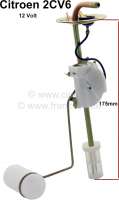
The 2CV’s fuel tank is located behind the rear axle, under the trunk floor. Throughout the entire production run of the 2CV, there were only two different tank types. Initially, a metal fuel tank was installed, which was used until the 1970s. This tank held 20 liters and featured a drain plug. In the 1970s, the model switched to a plastic fuel tank, which was installed until production ended. The new tank held 25 liters and measured 43 x 39 x 14 cm. The fuel sender is mounted inside the tank, with 6-volt and 12-volt versions available depending on the model year.
Fuel gauge displays incorrect information or has failed completely
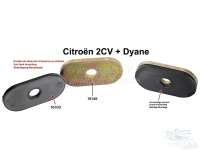
If the fuel gauge is not working, the cause is usually the fuel sender and not the fuel gauge itself. The fuel level sensors function as variable electrical resistors that change depending on the fuel level in the tank. So if the fuel gauge does not display a reading, either the power supply is interrupted (on the 2CV6, the connector for the fuel level sensor is located at the rear left in the wheel well under the felt trim) or the ground connection to the fuel level sensor is faulty. The fuel level sensor itself may also be defective. Especially nowadays, when gasoline contains a high percentage of ethanol, the ethanol corrodes the fuel level sensor (as well as the fuel pump, carburetor, fuel lines, etc.). Therefore, inactivity is the greatest enemy of our 2CV, as the open fuel system allows oxygen to come into contact with the fuel (resulting in the formation of acid). Regular driving of the 2CV and other classic cars is important to prevent the formation of corrosive acid caused by ethanol. Early 2CVs up through the 1970s, as well as the AMI6 and Dyane, had small covers in the trunk that concealed the fuel sender. In modern 2CVs, however, this feature was eliminated, so the fuel tank must be removed to work on the fuel sender.
The connection from the fuel tank to the engine
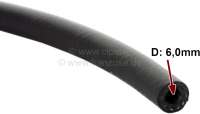
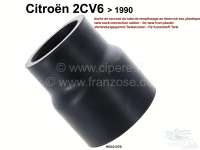
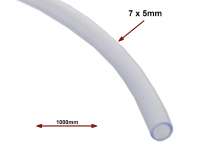
A flexible yet rigid plastic hose connects the fuel tank to the mechanically driven fuel pump.
Are there different fuel pumps for the Citroën 2CV?
There were differences in the fuel pumps: The first models had a horizontal inlet, while later models with 435cc and 602cc engines (M28 engine) only had fuel pumps with a bottom inlet and vertical fuel delivery to the carburetor.
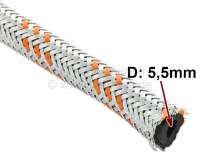
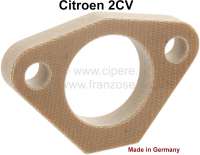
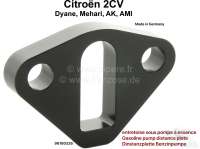
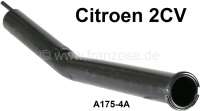
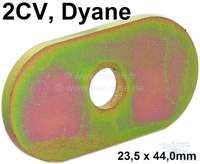
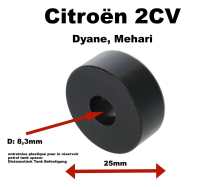
We carry all fuel pumps, new fuel tanks, fuel lines, fuel pump pushrods, and spacer plates for every 2CV engine as new parts. Fuel pumps with an additional manual override are also available in our inventory.
Do other Citroën A-series models have a different fuel system?
The 2CV’s fuel system was also used in the Dyane, Mehari, and AMI. Only the rare 4x4 models (2CV Sahara and Mehari 4x4) and the van versions of the 2CV (AZU, AK) and the Dyane (ACDY) had different fuel tanks.
Does the Citroën 2CV have a fuel return line?
What all 2CVs, Dyanes, Meharis, and AMIs have in common is the absence of a fuel return line to the fuel tank. This may seem somewhat unusual by today’s standards. The excess fuel produced when starting the engine is drained through the intake manifold. At its lowest point, beneath the carburetor, the manifold has a drain hole through which the fuel drips out over the engine block. This is why you smell gasoline during unsuccessful starting attempts.
It is extremely important that this drain hole is never blocked. If it becomes clogged, fuel accumulates in the intake manifold and can ignite, which in the worst case can lead to a fire in the 2CV.
What can you do if you want to start the 2CV after it has been sitting for a long time?
Here’s a tip: If the 2CV has been sitting for a long time, gasoline flows back from the pump into the tank. This causes the fuel pump diaphragm to dry out quickly. When you start the engine, it then takes a very long time for the fuel to be drawn in (and sometimes it doesn’t work at all). To fix this, simply remove the fuel cap and, while a second person starts the engine, blow forcefully into the tank (place your lips on the fuel filler neck!). This creates positive pressure in the tank, which pushes the fuel forward toward the fuel pump.
Are there any other tips?
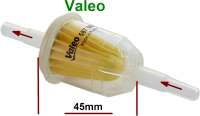
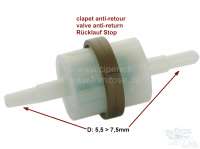
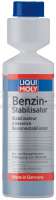
As an improvement, we also carry a fuel filter with a check valve. This prevents the fuel from flowing back so easily. Additionally, we offer fuel additives that can be added during a long planned downtime (winter break). These prevent the formation of acids in the fuel for a very long time. Furthermore, you should only use Super Plus gasoline.



 PDF FILE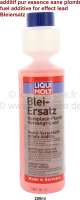

 VIDEO
VIDEO  Select your Citroen


 Please select your Peugeot


 Please select your Citroen Renault