2CV, 602ccm, engine gasket set without shaft seals. Installed from year of construction 1961 to
1969. Suitable for Citroen 3CV, Dyane, Ami6. Engine M4.


1969. Suitable for Citroen 3CV, Dyane, Ami6. Engine M4.
models with M28 engines manufactured during the years of construction 1970 to 1990. Original equipment quality!
of production) and 2CV4 with 435cc AYA2 engine. Original equipment quality!
For the 2CV6, there are two options: a basic engine gasket set and a complete engine gasket set.
The basic set typically includes the standard paper and rubber engine gaskets, but does not include crankshaft oil seals.
However, both engine gasket sets we offer also include the valve stem seals.
The complete set additionally includes the two crankshaft oil seals at the front and rear.
| Position | Dimension | Remarks |
|---|---|---|
| Crankshaft front | 30 × 42 × 8 mm | Nitrile, double-lip |
| Rear crankshaft / flywheel side | 56 × 69 × 10 mm | Nitrile, double lip |
The air-cooled 2CV boxer engine does not have a cylinder head gasket as found in water-cooled engines.
Many supposed “cylinder head gasket problems” in the 2CV6 are actually leaks in other areas:
| Area | Typical issue |
|---|---|
| Tappet tube gasket / “joints lunettes” of the tappet tubes | Oil runs down below the cylinders |
| Valve cover gaskets | Oil mist or drops on the cylinder heads |
| Rear crankshaft oil seal | Oil between the engine and transmission / in the clutch bell housing |
| Front crankshaft oil seal | Oil behind the fan / pulley |
| Oil cooler and oil line gaskets | Oil in the oil cooler area / at the front of the cylinder heads |
| Oil pump / engine block area | Oil on the lower engine block |
| Oil filler neck - Crankcase ventilation / Reniflard | Excess pressure causes new oil leaks |
Especially with the 2CV6, a leaky engine does not automatically mean that the engine was poorly sealed. Very often, the crankcase breather—that is, the oil filler neck or reniflard—is defective.
For a standard 2CV6, you should check the following:
The kit should be explicitly suitable for the 2CV6 / 602 cm³ / M28 / A06 from 1970 onward. These are our part numbers 10020 + 10137.
If the engine is removed or the flywheel or ventilation side is being disassembled anyway, you should use the complete set with both oil seals.
Otherwise, you’ll later be missing the very part that takes the most work to replace.
Yes, the valve stem seals are included in both of our engine gasket sets. However, there are many engine gasket sets on the market that do not always include them.
The pushrod seals are among the most critical seals in the 2CV engine.
An original installation note used to recommend unpacking and installing these gaskets only immediately before installation to ensure optimal rubber quality during installation. However, this note dates from a time when many other plasticizers were still used in the rubber gaskets.
Today, these materials are no longer permitted in this form within the EU. As a result, modern pushrod gaskets are often not as pliable as earlier original parts.
What this means for you: Pay even closer attention to whether the oil filler neck or reniflard is in good condition. If the engine builds up excess pressure, even new gaskets will quickly start leaking again.
Alternatively, improved pushrod gaskets made from modern materials can be used, such as those based on Viton. These are better able to withstand oil vapors, heat, and modern fuel and oil chemistry.
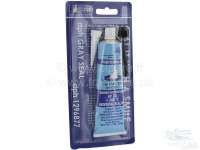
The 2CV engine cannot tolerate excessive silicone or sealant. Excess sealant can damage internal oil passages or the oil strainer.
It is also important to note: The 2CV engine is manufactured with such precision that no gasket was used between the engine block halves at the factory. The block halves were assembled dry. After disassembly, however, a very thin layer of a suitable engine sealant can be applied today.
As already mentioned, the 2CV engine does not have a traditional cylinder head gasket. It also lacks a cylinder base gasket.
It is fair to say that this small engine has been manufactured with remarkable precision since 1948. Many other manufacturers—whether the VW Beetle, Porsche, British sports cars, Mercedes, Alfa Romeo, or BMW—used gaskets in comparable locations. The little 2CV managed with particularly precisely machined sealing surfaces.
Added to this is the camshaft with two offset drive gears to prevent flank play. The result is very precise valve timing. That is why the 2CV6 engine can withstand long stretches of full throttle over many hundreds of kilometers without suffering any damage.
An interesting side note: camshafts with offset gears were also known as a typical tuning accessory for V2 Moto Guzzi engines.
Clean the engine thoroughly. Afterward, you should take a short test drive or run the engine at idle to pinpoint the exact location of the leak.
On the 2CV, oil is often blown far back by the airflow. Therefore, before replacing any gaskets, check the following:
A new oil seal is of little help if the engine builds up excess pressure due to a defective oil filler neck or reniflard.
The pushrod seals are among the most common sources of oil leaks on the 2CV6.
Important:
When installing the cylinder heads, do not force the tappet tube gaskets. The gasket must sit flush. If it is pinched during tightening, it will often leak again immediately.
The cylinder head bolts are tightened in the following order:
The first tightening is done at 1 daNm, the second at 2.5 daNm.
The values are given in daNm or mkg. For Nm, you can multiply by approximately 10.
| Step | Value |
|---|---|
| 1st pass | approx. 10 Nm |
| 2nd pass | approx. 25 Nm |
Caution: This is very low. Be sure to use a suitable torque wrench.
Next, adjust the valve clearance while the engine is cold:
| Valve | Clearance (cold) |
|---|---|
| Intake | 0.20 mm |
| Exhaust | 0.20 mm |
Some experts also set the intake to 0.15 mm. However, based on practical experience, it is recommended to set both the intake and exhaust to 0.20 mm when the engine is cold.
Valve clearance that is too tight can impair cylinder filling, reduce compression, and, in the worst case, lead to burnt valves. Slightly increased valve clearance, on the other hand, usually causes only a slight rattling but does not immediately result in engine damage.
Our tip: Set the intake and exhaust valves to 0.20 mm when the engine is cold (which is also the factory specification).
Valve covers are very often tightened too much. According to the 2CV torque chart, the tightening torque is 0.5 to 0.7 daNm, or about 5 to 7 Nm.
Important:
Practical tip: First, hand-tighten the valve cover nut. Then place a 12 mm ring wrench on it and tighten the nut using only your middle finger at the end of the ring wrench. This is usually sufficient.
Front oil seal: 30 × 42 × 8 mm
Procedure:
Rear oil seal: 56 × 69 × 10 mm
Special care is required here:
Torque values:
| Component | Value |
|---|---|
| Flywheel bolts | 3.8 daNm, i.e., approx. 38 Nm |
| Clutch mounting | 1 to 1.3 daNm, i.e., approx. 10 to 13 Nm |
On the flywheel side, you should also always check:
Cleanliness is crucial when working on the front engine area and the paper gaskets.
| Component | Value |
|---|---|
| Oil strainer | 0.3–0.5 daNm |
| Oil pump | 1.3–1.5 daNm |
| Oil cooler mounting | 1.9 daNm |
| Oil pressure switch | 3 daNm |
| Oil drain plug | 3.5–4.5 daNm |
The most common beginner mistakes are:
| Mistake | Consequence |
|---|---|
| Wrong 602-cc gasket set purchased | Shaft seals or valve stem seals are missing |
| Tappet tube gaskets installed upside down | Oil leak immediately after starting |
| Tappet tubes are out of round or have burrs | New gasket is damaged, oil leak |
| Valve cover tightened too tightly | Gasket is pushed out, oil leak |
| Oil seal installed dry | Sealing lip burns or wears down, oil leak |
| Oil seal installed at an angle | Immediate leakage |
| Crankshaft running surface not checked | New ring does not seal properly on old groove |
| Too much silicone or sealant used | Oil passages or oil strainer may be compromised; engine damage can occur quickly |
| Oil filler neck / breather not checked | Engine leaks oil despite new gaskets |
For a standard 2CV6 from 1970 onward, we do not recommend a minimal engine gasket set, but rather a complete engine gasket set:
By the way: You can also purchase all engine gaskets individually from us. This allows you to put together your own engine gasket set, including improved tappet tube gaskets.
All of our engine gasket sets for the 2CV are supplied by the original equipment manufacturer and brand supplier Glaser Spain. Glaser has been supplying engine gasket sets for Citroën since the 2CV was in production.
And very important before installation: First check the oil filler neck, or just buy a new one to be on the safe side. And use only the appropriate classic car oil 20W50.
Many 2CV6s start leaking again after a complete gasket replacement because the gaskets weren’t the actual problem—it was excessive crankcase pressure caused by a defective oil filler neck or breather. Remember: All 2CV6 engines are at least 40 years old!



 Select your Citroen


 Please select your Peugeot


 Please select your Citroen Renault